La guía completa para la toma de decisiones para compradores de marcas de playa, minoristas y vendedores de comercio electrónico.
Decidir si encargar un bolso de playa personalizado o comprar uno ya hecho al por mayor es una de las decisiones más importantes que toma una marca de ropa de playa en sus inicios; sin embargo, rara vez recibe el análisis estructurado que merece. Si aciertas, avanzas más rápido, reduces el riesgo de inventario y construyes una marca con gran impacto. Si te equivocas, te quedas con 2000 bolsos genéricos con los que nadie conecta, o has dedicado meses a desarrollar un producto personalizado que no llegó a tiempo para la temporada.
Esta guía te ofrece un marco claro y honesto para tomar esa decisión. Analizamos los costos reales, las ventajas y desventajas ocultas, los plazos y los escenarios en los que cada opción resulta más ventajosa. Además, te mostraremos cómo Domy Beach, un proveedor líder de productos de playa con sede en Yiwu, China, conecta ambos mundos de forma única, permitiendo a las marcas comenzar con productos prefabricados y escalar a la personalización sin cambiar de proveedor.
En resumen: ninguna de las dos opciones es universalmente mejor. La elección correcta depende de la situación actual de tu marca y de su proyección a futuro. Esta guía te ayudará a descubrirlo.
Definiendo los dos caminos
¿Qué es una bolsa de playa prefabricada?
Una bolsa de playa prefabricada es un producto prediseñado y prefabricado disponible para su compra inmediata directamente del inventario del proveedor. El diseño, los materiales, las dimensiones y la confección están predeterminados. Las opciones de personalización suelen limitarse a: un logotipo impreso o bordado, una etiqueta personalizada o una etiqueta interior con la marca.
Las bolsas prefabricadas son la forma más rápida de llegar al mercado. Dependiendo del proveedor, puedes hacer un pedido y recibir el producto con tu marca en tan solo 2 o 3 semanas. Son especialmente atractivas para marcas que están probando una nueva categoría, realizando una promoción de temporada o lanzándose con un capital limitado.
¿Qué es una bolsa de playa personalizada?
A bolsa de playa personalizada Se desarrolla desde cero (o a partir de una muestra base modificada) según sus especificaciones exactas. Usted controla: la forma y la silueta, la composición y el peso del material, los herrajes (cremalleras, cierres, anillas), la distribución interior, la paleta de colores, los detalles de costura y acabado, y por supuesto, todos los elementos de marca. El producto no existe en ningún otro lugar hasta que usted lo cree.
La producción a medida requiere plazos de entrega más largos, una mayor inversión inicial y una colaboración más estrecha con el socio fabricante. Pero también produce algo que ningún competidor puede replicar: un producto que es una expresión auténtica de su marca.
El modelo híbrido: el camino que realmente siguen la mayoría de las marcas.
En la práctica, las marcas de playa más exitosas no optan por una estrategia binaria. Comienzan con colecciones listas para usar para validar la demanda y generar ingresos iniciales, y luego, a medida que crecen, desarrollan colecciones personalizadas. Este modelo híbrido es precisamente lo que Domy Beach busca respaldar: un proveedor que gestiona inventario listo para etiquetar y programas de desarrollo personalizados bajo un mismo techo, con el mismo gestor de cuentas guiándote en ambas fases.
Comparación lado a lado
El cuadro de mando completo
| Criterios | Bolsa de playa personalizada | Bolsa de playa lista para usar |
| Diferenciación de marca | ★★★★★ Totalmente único: ningún competidor ofrece el mismo producto. | ★★½ Diferenciación únicamente por logotipo; el mismo producto base puede existir en otros lugares. |
| Tiempo de comercialización | ★★ 8-16 semanas (diseño, muestra, producción, envío) | ★★★★★ Entrega en 2-4 semanas desde el pedido. |
| Cantidad mínima de pedido | ★★★ Normalmente, un mínimo de 100 a 500 unidades por estilo. | ★★★★★ Desde 50 unidades (en Domy Beach) |
| Costo unitario | ★★★ Mayor costo unitario en volúmenes bajos; competitivo a gran escala | ★★★★★ Menor costo unitario, sin gastos generales de desarrollo. |
| Inversión inicial | ★★ Costo de la muestra: $100-500; se requiere una mayor inversión en diseño. | ★★★★ Mínimo: solo costo del producto + tarifa de configuración del logotipo |
| Control de diseño | ★★★★★ 100% control sobre cada detalle | ★★ Limitado a elementos de marca de forma fija. |
| Riesgo de mercado | ★★★ Superior: compromiso total del inventario antes de la respuesta del mercado. | ★★★★★ Menor: lotes pequeños para probar la demanda con mínima exposición |
| Escalabilidad | ★★★★★ Se puede volver a pedir fácilmente con sus especificaciones exactas fijadas. | ★★★ La disponibilidad de existencias puede variar de una temporada a otra. |
| Consistencia del producto | ★★★★★ Especificaciones idénticas en cada lote; la fábrica guarda su plantilla. | ★★★ Depende de que el proveedor mantenga el mismo producto base. |
| Opciones de sostenibilidad | ★★★★★ Especifique los materiales exactos y las certificaciones (GRS, OEKO-TEX). | ★★★ Limitado a lo que hay en stock de material prefabricado. |
| Embalaje y desempaquetado | ★★★★★ Bolsas guardapolvo, cajas, papel de seda y etiqueta colgante con la marca completa. | ★★★ Embalaje estándar; etiqueta colgante de la marca disponible normalmente |
| Ideal para | Marcas en crecimiento, colecciones exclusivas, cuentas mayoristas | Primeros pedidos, promociones de temporada, reposición rápida, pruebas |
Las valoraciones son orientativas. Las cifras exactas dependen del proveedor, el volumen del pedido y la complejidad del producto. Domy Beach ofrece opciones personalizadas a partir de 100 unidades y productos prefabricados a partir de 50 unidades.
La realidad de los costos: lo que los compradores suelen calcular mal.
Comparación de costos reales (por unidad, pedido de 300 unidades)
La mayoría de los compradores comparan el precio unitario indicado en la etiqueta y ahí se detienen. Ese es un cálculo erróneo. El costo real de cada opción incluye la inversión en desarrollo, la eficiencia logística y el costo de tomar una decisión equivocada.
| Componente de costo | Bolsa de playa personalizada | Bolsa de playa lista para usar |
| Precio unitario base (300 unidades) | $8 – $22 según las especificaciones | $5 – $14 del stock existente |
| Tarifa de muestra/desarrollo | $100 – $500 (reembolsable en Domy Beach con el primer pedido) | $0 – $50 para configuración de logotipo |
| Tiempo de iteración del diseño | De 2 a 4 semanas de idas y venidas. | Aprobación de la obra de arte el mismo día |
| Prima de flete aéreo (urgente) | A menudo necesario; añade $1-3/unidad | Rara vez necesario; transporte marítimo viable |
| Costo del riesgo de inventario | Mayor: compromiso total antes de la validación del mercado | Inferior: posibilidad de lote de prueba pequeño |
| Flexibilidad de reordenamiento | Consistente; especificación fijada | Variable; depende del stock |
| Potencial de prima de marca | Alto: un producto único tiene un precio de venta al público más elevado. | Moderado: el logotipo limita la diferenciación. |
| Costo total aproximado de desembarque | $10 – $28 / unidad (total en 300 piezas) | $7 – $18 / unidad (todo incluido en 300 piezas) |
La opción personalizada tiene un costo unitario mayor en volúmenes bajos, pero este sobreprecio suele compensarse con precios de venta al público más altos, posibles gracias a una diferenciación genuina. La opción prefabricada ofrece una entrada más rápida y económica, ideal para validar la demanda, no para la construcción de marca a largo plazo.
El coste oculto de equivocarse
El verdadero riesgo financiero no reside en los costes de desarrollo, sino en el inventario sin vender. Una marca que lanza una colección completa de bolsos personalizados sin validar previamente la demanda puede acabar con cientos de unidades sin vender. Por el contrario, una marca que recurre año tras año a bolsos genéricos prefabricados tendrá cada vez más dificultades para justificar precios elevados o fidelizar a sus clientes.
Las marcas más inteligentes utilizan productos prefabricados para generar flujo de caja e información de mercado, y luego canalizan esos aprendizajes hacia el desarrollo de productos personalizados. Este enfoque por etapas minimiza ambos riesgos simultáneamente.
Análisis en profundidad del plazo de entrega: La decisión sobre el momento oportuno
Cronograma de entrega de bolsos personalizados (expectativas realistas)
Muchos compradores subestiman el tiempo que realmente requiere el desarrollo de un producto personalizado. Aquí les presentamos un cronograma realista para un nuevo bolso de playa personalizado, desde la idea inicial hasta la entrega:
| Fase | Periodo de tiempo | Notas |
| Resumen del diseño y desarrollo de las ilustraciones | 1 a 5 días hábiles | Gratis en Domy Beach; primer borrador disponible las 24 horas. |
| Producción de muestras | 7-15 días hábiles | Se envió una muestra física para su aprobación. |
| Rondas de revisión y corrección de muestras | De 3 a 10 días hábiles | Normalmente, entre 1 y 2 ciclos de revisión. |
| Producción a gran escala | 3-5 semanas | Varía según el tamaño y la complejidad del pedido. |
| Transporte marítimo a EE. UU. | 25 – 40 días | Transporte aéreo: 7-12 días a un costo mayor. |
| SERVICIO COMPLETO DE PUERTA A PUERTA | 10-16 semanas | Planifique con 4 meses de anticipación a la fecha de venta prevista. |
Cronograma predefinido
Los productos prefabricados reducen drásticamente este ciclo. Con un proveedor como Domy Beach que mantiene inventario físico:
Confirmación de estilo: el mismo día
Aprobación del diseño y configuración del logotipo: 1-2 días hábiles
Producción/etiquetado: 3-7 días hábiles
Transporte aéreo a EE. UU.: 7-12 días
Total desde el pedido hasta la entrega: en tan solo 2-3 semanas
Para las marcas que se lanzan antes del verano, que operan con plazos ajustados o que necesitan reponer rápidamente sus existencias, esta ventaja de velocidad suele ser decisiva.
Diseño y diferenciación de productos: El argumento de la marca
Qué se puede y qué no se puede personalizar en una bolsa prefabricada
La personalización estándar suele incluir: logotipo bordado o impreso en el exterior, etiqueta tejida o impresa en el interior, etiqueta colgante con su marca y, en ocasiones, la posibilidad de elegir el color o la longitud de la correa, si el proveedor lo ofrece. Lo que normalmente no se puede modificar es: la silueta, las dimensiones, el gramaje del material, el estilo de los herrajes, la disposición de los bolsillos interiores o el tipo de cierre.
Para las marcas cuya identidad está ligada a una característica estética o funcional específica —un cierre inusual, una textura tejida a mano, un tono específico de lona natural o un compartimento interior personalizado—, los productos prefabricados no satisfacen las necesidades de la marca para tener una apariencia y una sensación distintivas.
Lo que la personalización completa hace posible
El desarrollo totalmente personalizado abre un abanico completo de posibilidades de diseño. En Domy Beach, los clientes tienen control creativo total sobre:
Silhouette and structure: tote, bucket, barrel, zip-top, drawstring, frame bag, backpack-style, or hybrid shapes
Materials: natural canvas, cotton-linen blends, raffia/straw weave, RPET recycled polyester, jute, waxed cotton, PVC panels, vegan leather trim, and more
Hardware: rope handles, bamboo rings, wooden toggles, metal clasps, custom-color zippers, D-rings, magnetic snaps
Interior: pocket configuration, lining material, waterproof coating, key clip attachment
Finishing details: contrast stitching, raw edge treatment, tassel detail, custom embroidery, all-over pattern printing
Packaging: branded dust bag, tissue wrap, printed box, individual poly bag with barcode
This level of control is what separates a private-label product from a brand product. A custom beach bag can be patented in its design, photographed as a hero product, and priced at two to three times the cost of a comparable ready-made equivalent — because it genuinely is different.
The 2025 Trend Context
Current U.S. beach bag design trends strongly favor the kind of customization only fully custom production can deliver: oversized structured totes with natural texture finishes, earthy neutrals (sand, driftwood, terracotta), artisanal details like rope handles and shell hardware, embroidered motifs in a ‘quiet luxury’ aesthetic, and sustainability storytelling through certified materials. None of these are achievable at a branding level on a standard ready-made bag. They require material selection control and production-stage design input — precisely what full custom delivers.
Scenario Guide: Which Option Wins for You?
| Your Situation | Recommended Path | Why |
| First-time beach brand launch, under $5K budget | Ready-Made | Minimal upfront investment; validate the concept before committing to custom tooling |
| Seasonal promo order for resort or hospitality client | Ready-Made | Speed and logo branding are all you need; no time for sample cycles |
| Amazon FBA seller testing a new beach bag SKU | Ready-Made First | Start with 50-100 units to read ASIN performance before scaling to custom |
| Established brand launching a signature collection | Custom | Your brand equity demands a product no one else sells; differentiation is the entire value proposition |
| Wholesale brand pitching boutique retailers | Custom | Buyers at boutiques expect exclusive product; ready-made kills the pitch |
| Brand expanding from hats into bags for brand cohesion | Custom | Consistent aesthetic across categories requires spec-level control over materials and finishes |
| Corporate gifting / branded merchandise campaign | Ready-Made | Logo + quantity + fast delivery is the formula; design depth is irrelevant |
| DTC brand with strong social following building hero SKU | Custom | Your audience will notice if your hero bag is also sold by five other brands with a different logo |
| Beach brand scaling from $50K to $500K revenue | Both (Hybrid) | Ready-made for in-season replenishment; custom for core collection development |
How Domy Beach Serves Both Paths — And the Space Between
About Domy Beach
Domy Beach (Yiwu Domy Garment Co., Ltd.) is a one-stop beach product supplier headquartered in Yiwu, Zhejiang, China — the world’s largest small commodities trading hub. The company serves U.S. beach brands, resort retailers, e-commerce sellers, and wholesale buyers with a complete product ecosystem: straw hats, beach bags, beach apparel (board shorts, fishing shirts), and accessories.
Unlike most Chinese suppliers who specialize in either ready-made stock or custom development, Domy Beach operates both tracks simultaneously, giving buyers the rare ability to source an entire brand collection — at any stage of development — without switching partners.
Ready-Made at Domy Beach
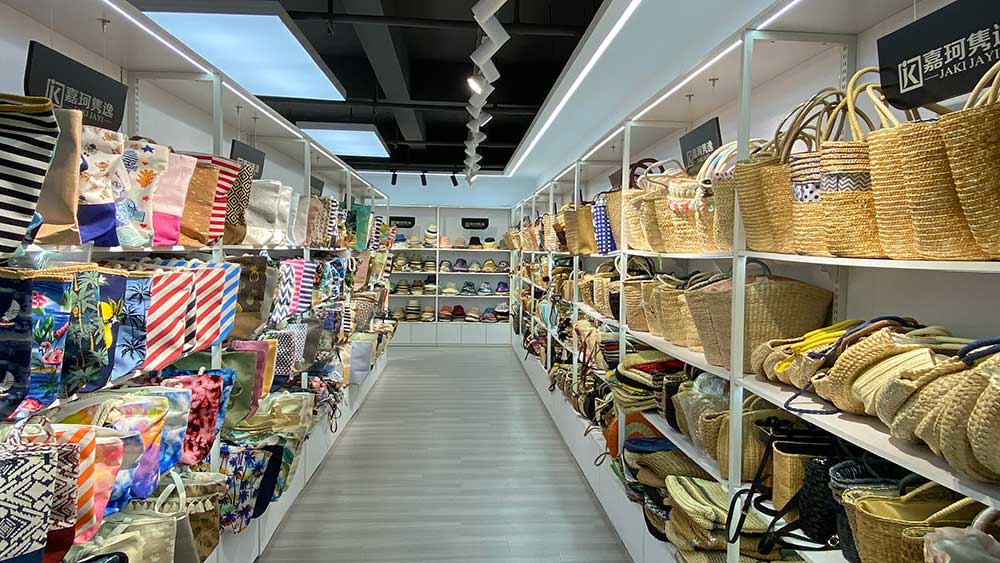
Catalog of 2,000+ ready-to-label beach bags spanning canvas totes, mesh bags, straw/raffia bags, waterproof styles, drawstring bags, and woven bucket bags
MOQ from just 50 pieces per style
Logo application options: embroidery, screen print, heat transfer, woven label
Custom hang tags and inner labels included
Lead time: as fast as 2-3 weeks door-to-door (air freight to U.S.)
Sample available for review before bulk commitment
Custom Development at Domy Beach
Full OEM/ODM design service: bring a sketch, a reference image, or just an idea
Free 24-hour design turnaround — no design files required from the client
MOQ from 100 pieces for most custom styles
Sample fee: $100-300, fully credited against first bulk order
Complete material library: natural canvas, RPET, jute, cotton-linen, raffia, vegan leather trim, waterproof PVC panels
Hardware sourcing: rope handles, bamboo, wood, metal, custom-color zippers
Full packaging development: dust bags, printed boxes, branded tissue, hang tags with barcodes
1-on-1 dedicated account manager through every stage
Bilingual support (English/Chinese) with WhatsApp, email, and video call
The One-Stop Advantage for Beach Brands
What makes Domy Beach genuinely different is the ability to combine beach bags with hats, apparel, and accessories in a single order, shipped together. A brand building out a complete summer collection can order straw hats, tote bags, and fishing shirts in one transaction — consistent branding, consistent quality, consolidated freight, one supplier relationship to manage. This is not something most bag-only or hat-only suppliers can offer.
Additionally, Domy Beach’s cargo consolidation service allows buyers sourcing from other Chinese suppliers to route all goods through Domy’s warehouse for combined export — reducing logistics costs and simplifying U.S. customs clearance.
The Decision Framework: A Practical Checklist
Use the questions below to quickly identify which path is right for your next order:
| Question | If YES → Consider | If NO → Consider |
| Do I need product in hand within 4 weeks? | Ready-Made | Custom |
| Is my order under 100 pieces? | Ready-Made | Either |
| Am I validating a new product concept for the first time? | Ready-Made | Custom |
| Is design uniqueness core to my brand positioning? | Custom | Ready-Made |
| Will I be pitching this product to boutique retailers or press? | Custom | Either |
| Do I need a specific sustainable material or certification (GRS, OEKO-TEX)? | Custom | Ready-Made |
| Do I already have proven sell-through data on a similar product? | Custom | Ready-Made |
| Am I building a cohesive collection across hats, bags, and apparel? | Custom | Either |
Conclusion: The Real Answer
Custom beach bags win on brand differentiation, design control, and long-term scalability. Ready-made wins on speed, low investment, and risk management. Neither is categorically better — the right choice is the one that matches your brand’s stage, timeline, and commercial objectives.
The brands that grow fastest aren’t the ones that pick a side and stay there. They use ready-made to learn, and custom to lead. And they do it with a supplier that supports both — seamlessly, affordably, and without the complexity of managing two separate factory relationships.
Domy Beach is built for exactly that kind of brand. Whether you’re ordering 50 ready-to-ship canvas totes to test a new sales channel, or developing a full custom straw bag collection for next summer’s launch, the team at domybeach.com is ready to support you — with free design, low MOQs, 1-on-1 account management, and a product catalog that spans the entire beach lifestyle category.
Your next beach bag collection starts with a single conversation.
FREQUENTLY ASKED QUESTIONS
Custom Bags: Design & Development
Q1. How long does it really take to develop a custom beach bag from scratch?
Realistically, plan for 10-16 weeks from first brief to U.S. delivery: 1-5 days for design artwork, 7-15 days for sample production, 3-10 days for sample review and any revisions, 3-5 weeks for bulk production, and 25-40 days for ocean freight. If you use air freight, you can shave 2-4 weeks off the back end. At Domy Beach, the design and artwork stage is free and typically completed within 24 hours of your brief, which helps compress the early phases significantly.
Q2. Do I need to provide design files or technical specs to start a custom bag?
No. At Domy Beach, you only need to share reference images (screenshots, Pinterest pins, photos of bags you like) and a brief written description of what you want — dimensions, color direction, materials, and how you want your logo applied. The design team takes it from there, delivering a full artwork package with mockups within 24 hours. You don’t need a tech pack, CAD drawings, or prior manufacturing experience to launch a custom product.
Q3. What materials can I specify for a fully custom beach bag?
The material options are broad. Most popular for the U.S. beach market: heavy cotton canvas (12oz or 16oz), cotton-linen blends, natural raffia or paper straw weave, RPET recycled polyester (for eco-positioned brands), jute with cotton lining, waxed canvas, and Oxford polyester for waterproof utility bags. Premium finishing options include vegan leather handles, bamboo or wooden rings, PVC transparent panels, and rope or macrame detailing. If you have a specific material in mind that’s not listed, ask — Domy Beach’s sourcing team can evaluate it.
Q4. How much does a custom bag sample cost, and is it refundable?
At Domy Beach, sample fees typically range from $100 to $300 depending on complexity. This fee is fully refunded (credited) against your first bulk order. Most buyers need one to two revision rounds before approving a sample for production, which is included in the process. If you’re not satisfied with the final sample, you’re under no obligation to proceed to bulk production.
Q5. What is the minimum order quantity for a custom beach bag at Domy Beach?
Most custom beach bag styles start at 100 pieces per design. Some more complex constructions or specialty materials may require 200-300 pieces. Sizes can be mixed within a single style (e.g., a small and large version of the same design counting toward the combined MOQ). If you’re unsure whether your target quantity qualifies, contact Domy Beach directly — the team evaluates requests on a case-by-case basis and aims to find a workable solution for growing brands.
Q6. Can I get my custom bag design protected or exclusive?
Domy Beach signs non-disclosure agreements (NDAs) and confidentiality agreements to protect client designs during development. For formal intellectual property protection, you should register your design with the U.S. Patent and Trademark Office (USPTO) independently — this is separate from any supplier relationship. However, once a design is approved and produced, Domy Beach will not reproduce it for any other client without your consent.
Ready-Made Bags: Selection & Ordering
Q7. What types of ready-made beach bags are available at Domy Beach?
Domy Beach’s ready-made catalog currently includes over 2,000 styles spanning: canvas open totes, zipper-top canvas bags, mesh beach bags, natural straw and raffia bags, waterproof PVC or polyester bags, drawstring bags, rope-handle bucket bags, woven straw clutches, and oversized beach blanket carriers. New styles are added monthly based on global trend tracking. You can browse the full catalog at domybeach.com or request a PDF catalog from your account manager.
Q8. What branding options are available on a ready-made bag?
Standard ready-made customization options include: embroidered logo on the exterior (most durable), screen-printed logo (best for complex multi-color designs), heat transfer label, woven fabric label (inside or outside), and custom hang tag with your brand name, logo, and any product information. The specific application method recommended will depend on the bag’s material — your account manager will advise on which method works best for your chosen style.
Q9. How quickly can I receive a ready-made beach bag order?
For buyers in the U.S., the fastest realistic timeline is 2-3 weeks via air freight: 1-2 days for artwork approval, 3-7 days for logo application and quality check, and 7-12 days for air freight transit. Ocean freight (25-40 days) is significantly cheaper and suitable if you have more lead time. Domy Beach maintains physical inventory for most catalog styles, so there is no production wait — only branding application time.
Q10. Can I order a sample of a ready-made bag before committing to a full order?
Yes. Domy Beach can send a sample of any catalog style (unbranded or with your logo applied) before you commit to a bulk order. Sample lead times are typically 3-7 days for an unbranded sample and 7-14 days for a branded sample. Sample costs are nominal and credited toward your first order. Reviewing a physical sample before bulk production is strongly recommended, even for ready-made styles, to confirm you’re satisfied with the quality before committing.
Cost, MOQ & Payment
Q11. What is the typical price range for ready-made vs custom beach bags from China?
Ready-made bags from Domy Beach’s catalog typically range from $5 to $14 per unit at 100-300 piece order quantities, depending on style and material. Custom bags range from $8 to $25+ per unit at comparable quantities, with the price reflecting material cost, hardware complexity, and production labor. Both price ranges exclude freight and import duties. Volume discounts apply to both tracks as order sizes increase. Request a quote with your specific requirements for accurate pricing.
Q12. Are there volume discounts? How do prices change at scale?
Yes. Both ready-made and custom pricing improves meaningfully with volume. For custom bags, unit costs at 500 pieces are typically 15-25% lower than at 100 pieces. At 1,000+ pieces, savings of 30-40% versus the minimum quantity price are common. Ready-made pricing similarly steps down with volume. Long-term partner accounts may also access tiered pricing structures based on cumulative annual order value. Domy Beach’s account managers provide custom quotations for any order scenario.
Q13. What are the payment terms?
Standard terms at Domy Beach: 50% deposit upon order confirmation, 50% balance payable before shipment. Accepted payment methods include PayPal, major credit cards, and bank wire transfer (T/T). For established long-term clients, alternative payment schedules can be negotiated. Sample fees are invoiced separately and credited in full against the first qualifying bulk order.
Logistics, Tariffs & Compliance
Q14. What U.S. import duties apply to beach bags from China in 2025?
The effective combined tariff rate on Chinese-made beach bags (MFN base rate + Section 301 duties) in 2025 typically ranges from 15% to 34% depending on the bag’s material and HTS tariff code. Canvas and natural fiber bags may carry different rates than synthetic or PVC styles. Domy Beach provides detailed product specifications, HTS code guidance, and country-of-origin documentation to support your import filing. We strongly recommend consulting a licensed U.S. customs broker before finalizing your cost model.
Q15. Can I combine beach bags with hats or apparel in the same shipment?
Absolutely — this is one of Domy Beach’s defining advantages. Because Domy Beach covers beach bags, straw hats, and beach apparel in one catalog, orders can include all three product categories in a single shipment. This eliminates the need to manage separate freight bookings and simplifies your customs clearance. Additionally, Domy Beach’s cargo consolidation service lets you route goods from other Chinese suppliers through Domy’s warehouse for combined export.
Q16. Are sustainable or certified materials available for custom bags?
Yes. Domy Beach supports sustainable sourcing for custom bag development, including RPET (recycled polyester from plastic bottles), organic cotton, GRS (Global Recycled Standard) certified materials, and OEKO-TEX certified fabrics. For brands building a sustainability narrative, Domy Beach can also assist with sourcing certifications and providing the material documentation you need for marketing claims. Notify your account manager of specific certification requirements during the design brief phase.
Working with Domy Beach
Q17. How do I get started with a beach bag order at Domy Beach?
The process is simple: (1) Visit domybeach.com and fill out the inquiry form, or reach out directly via WhatsApp; (2) A dedicated account manager contacts you within 24 hours; (3) Share your requirements — whether you want to browse the ready-made catalog or start a custom development; (4) For ready-made: select styles, approve artwork, pay deposit; (5) For custom: share your design reference, receive artwork within 24 hours, approve sample, then proceed to bulk. The entire process is supported in English with no minimum experience required.
Q18. Can I order both ready-made and custom bags in the same order?
Yes. Many Domy Beach clients run a hybrid order: ready-made styles with logo branding for immediate stock needs, alongside a custom development project being worked on in parallel. Having both tracked by the same account manager means seamless coordination — timelines are managed together, and goods can be shipped in a single consolidated freight booking whenever possible.
Q19. What quality control measures are in place for beach bag production?
Domy Beach’s quality management system operates across four checkpoints: incoming raw material inspection before production begins; in-process random sampling during cutting, sewing, and finishing stages; finished goods QC check before packaging; and a final pre-shipment audit. For custom orders, production only commences after the buyer has signed off on a confirmed sample. For ready-made orders, the branded product goes through a final check before shipping. Any quality issues identified post-delivery are handled through Domy Beach’s documented after-sales resolution process.
Q20. What if I start with ready-made and want to transition to custom later?
This is the most common journey for Domy Beach clients — and the transition is completely seamless. Your account manager stays the same, your brand preferences and order history are on file, and the supplier relationship you’ve built carries over directly into the custom development process. Many brands use their first 1-2 ready-made orders to generate cash flow and market data, then use those learnings (which styles sell, which colors move fastest, what customers say about features) to inform the design brief for their first custom collection. Domy Beach actively guides this transition and can even use sell-through data from your ready-made experience to recommend custom product directions.