
Sourcing custom beach products from China is one of the highest-leverage decisions a growing beach brand can make. Done well, it gives you access to world-class manufacturing, competitive pricing, and product differentiation that is impossible to achieve through domestic sourcing or generic wholesale platforms. Done poorly, it produces delayed shipments, substandard products, miscommunicated specifications, and capital tied up in unsellable inventory.
This guide is built on one premise: information eliminates most of the risk. The buyers who get burned sourcing from China are overwhelmingly first-timers who acted on incomplete information — who didn’t know what questions to ask, what red flags to look for, or how the process actually works from brief to delivery. This guide closes those gaps.
We cover every step of the sourcing process, from defining your product and understanding the Chinese manufacturing landscape, through finding and vetting suppliers, managing sampling and production, navigating logistics and U.S. customs, and building a supplier relationship that compounds over time. At each stage, we ground the guidance in the specific realities of the beach product category: straw hats, beach bags, fishing shirts, board shorts, and accessories.
Throughout this guide, we reference Domy Beach (Yiwu Domy Garment Co., Ltd., domybeach.com) as an example supplier. Domy Beach is a one-stop beach product supplier in Yiwu, China, covering straw hats, beach bags, and beach apparel with custom development from 100 pieces and ready-made from 50 pieces. Where Domy Beach’s specific policies or processes illustrate a broader point, we identify them clearly. Our aim throughout is practical guidance, not a sales pitch.
Why China? The Case for the World’s Dominant Beach Product Manufacturer
Before investing time in the sourcing process, it’s worth understanding exactly why China dominates this category — and why that dominance is likely to persist in 2025 and beyond.
Manufacturing Cluster Depth
China’s beach product manufacturing is not spread uniformly across the country. It is concentrated in a small number of highly specialized clusters where the entire supply chain — raw materials, component suppliers, skilled labor, export logistics, and trade services — coexists within a few kilometers. The most important clusters for U.S. beach product buyers are:
Yiwu, Zhejiang: The world’s largest small commodities market and one of the most prolific straw hat and beach accessory sourcing hubs globally. Yiwu is where Domy Beach operates. The city’s unique ecosystem of tens of thousands of suppliers, a dedicated international trade market, and mature freight forwarding infrastructure make it the most practical single-destination sourcing location for beach brands building mixed-category collections.
Qingdao, Shandong: A major hub for straw hat and natural fiber hat manufacturing at scale. Home to some of China’s largest hat factories by volume.
Guangzhou and Shenzhen, Guangdong: Dominant in structured caps, custom embroidery headwear, and fashion accessories. Strong for buyers needing complex decoration work or sourcing alongside electronics or promotional merchandise.
Baoding, Hebei: Historically significant for hat manufacturing and still home to several established exporters.
This cluster structure means that when you source beach products from China — especially from Yiwu — you are not just buying from a single factory. You are accessing an entire ecosystem of material suppliers, trimmings vendors, packaging producers, and logistics partners that collectively make fast, affordable, high-quality custom production possible.
The Competitive Advantages That Actually Matter
Full-category depth: No other country simultaneously offers custom straw hats, woven beach bags, beach apparel, and accessories at comparable quality, speed, and price.
Design and sampling speed: A competent Chinese supplier with an in-house design team can return a first design concept within 24-48 hours and a physical sample within 7-15 days. This product velocity is simply not replicated elsewhere.
MOQ flexibility: Chinese suppliers — particularly in Yiwu — have invested heavily in serving small international buyers. MOQs of 50-100 pieces are genuinely achievable for branded ready-made products; 100-200 pieces for most custom styles. This is not typical of manufacturing in Vietnam, Bangladesh, or India.
Price-to-quality ratio: A high-quality custom straw hat made in China can be sourced for $4-12 ex-factory depending on complexity and volume. An equivalent product sourced domestically in the U.S. would cost multiples more with longer lead times.
The 2025 Tariff Reality: Honest Assessment
U.S.-China trade tensions have added meaningful cost pressure to beach product imports. The current tariff environment for most beach hat and bag categories from China combines the baseline MFN (Most Favored Nation) rate, Section 301 duties imposed since 2018, and any additional levies. The cumulative effective rate on beach hats and bags from China typically falls in the range of 15–30%+ depending on the specific HTS (Harmonized Tariff Schedule) code and material composition.
This is real cost pressure that must be factored into your landed cost model. However, three considerations put it in perspective:
Alternative sourcing countries have not eliminated the problem. Vietnam and Bangladesh face growing tariff exposure of their own, and neither matches China’s beach product manufacturing depth for custom development at low MOQs.
The tariff burden applies to the ex-factory price, not your retail price. At typical beach brand markups (3-5x landed cost), the tariff impact on margin is manageable when factored in at the outset rather than discovered at customs clearance.
Larger-format commercial B2B imports are now structurally advantaged. The elimination of the $800 de minimis exemption for Chinese goods (effective May 2025) has crushed small-parcel direct-to-consumer models (Temu, Shein), but has no material impact on the commercial wholesale import model that professional beach brand buyers use.
| ✓ Always calculate landed cost, not unit priceYour true cost per unit includes: ex-factory price + freight + U.S. import duties + customs brokerage fees + last-mile delivery. For a typical beach hat from China shipped by sea, duties and freight combined often add $1.50-4.00 per unit on top of the factory price. Build this into your pricing model before, not after, committing to an order. |
Beach Product Categories: What Can Be Sourced from China
Understanding what Chinese manufacturers actually produce — and how the sourcing process differs by category — prevents misaligned expectations and wasted time.
Straw Hats & Beach Hats
What’s available
China manufactures the full spectrum of beach headwear: wide-brim floppy hats, Panama hats, fedora straw hats, cowboy straw hats, bucket hats in natural and fabric materials, visors, bucket hats, lifeguard hats, and packable travel hats. Both natural-fiber (raffia, paper straw, wheat straw, seagrass, bamboo) and synthetic/mixed-material styles are widely produced.
What determines cost
Material: Natural raffia and high-grade toquilla grass command premium pricing vs. paper straw and woven synthetic fiber.
Brim width: Wider brims (12cm+) require more material and shaping effort, increasing cost.
Construction complexity: Fully handwoven styles cost more than machine-woven; brim-stiffening and internal structure add cost.
Decoration: Embroidery, heat-transfer logos, woven labels, and patch badges each have different costs and minimum quantities.
Typical ex-factory price range
Basic paper straw beach hat, logo embroidery: $3.50 – $6.00 at 200 pcs
Mid-grade natural raffia wide-brim hat: $5.50 – $10.00 at 200 pcs
Premium handwoven toquilla or high-grade raffia hat: $9.00 – $18.00 at 200 pcs
Beach Bags
What’s available
The beach bag category in China covers: open canvas totes, zippered canvas bags, natural straw and raffia woven bags, waterproof PVC or polyester bags, mesh bags, drawstring bags, rope-handle bucket bags, jute bags, and oversized beach carry bags. Both mass-production ready-made styles and fully custom designs are available.
What determines cost
Material: Natural straw and raffia are typically more expensive than canvas or polyester for comparable sizes.
Construction: Reinforced bases, waterproof linings, zipper closures, and interior pockets each add cost.
Hardware: Bamboo rings, wooden toggles, metal clasps, and rope handles add meaningful cost vs. simple fabric handles.
Size: Large oversized totes require significantly more material than standard sizes.
Typical ex-factory price range
Standard canvas open tote, 38x40cm, logo print: $2.50 – $5.50 at 300 pcs
Natural raffia woven tote, medium size: $4.50 – $9.00 at 200 pcs
Premium oversized beach bag, waterproof lining, bamboo handles: $8.00 – $16.00 at 200 pcs
Beach Apparel (Fishing Shirts, Board Shorts, Cover-Ups)
What’s available
China’s Guangdong, Fujian, and Jiangsu provinces host the world’s largest concentration of apparel manufacturers. For beach-specific apparel, key categories include: UPF 50+ sun-protective fishing shirts (long-sleeve and short-sleeve), board shorts and swim trunks, beach cover-ups, rash guards, and casual resort wear.
What determines cost
Fabric specification: Performance fabrics (UPF polyester, quick-dry blends) cost more than standard cotton or poly-cotton.
Print complexity: All-over sublimation printing adds cost vs. logo-only decoration.
Construction details: Zippered pockets, elastic waistbands with drawstrings, mesh lining in shorts all affect pricing.
Certification: UPF 50+ testing and certification documentation adds a modest upcharge per style.
Typical ex-factory price range
Basic board shorts, logo embroidery or print, polyester: $5.00 – $9.00 at 100 pcs
UPF 50+ long-sleeve fishing shirt: $7.00 – $14.00 at 100 pcs
Premium sublimation-print fishing shirt, full-coverage design: $10.00 – $18.00 at 100 pcs
What One-Stop Means and Why It Matters
Most buyers sourcing from China manage multiple suppliers for different product categories. If your beach brand needs hats, bags, and apparel, the default path is to find a hat factory, a separate bag factory, and a separate apparel factory — and manage three independent supplier relationships, three separate sample processes, three separate shipments, and three different quality standards.
One-stop suppliers like Domy Beach eliminate this fragmentation. A single order can cover straw hats, beach bags, and fishing shirts, managed by one account manager, shipped in one consolidated freight booking. For brands building cohesive seasonal collections, this integration is not just convenient — it ensures material palette consistency, visual design alignment, and dramatically reduces operational complexity.
| ★ Domy Beach: One-Stop Coverage in PracticeDomy Beach offers straw hats, beach bags, beach apparel (fishing shirts, board shorts), and accessories from a single Yiwu location. MOQ from 50 pcs (ready-made) and 100 pcs (custom). All categories available for full custom development or ready-to-label. Free 24-hour design service. Orders across all categories can be consolidated into a single freight shipment. |
Finding Suppliers: Channels, Trade-offs, and What Actually Works
The first question every new buyer asks is: where do I find suppliers? The more important question is: which channel is right for my situation and order profile?
Online Sourcing Platforms
Online B2B platforms are the default starting point for most buyers. The three major platforms relevant to beach product sourcing are:
Alibaba: The largest by volume, with the broadest supplier coverage. The key challenge is distinguishing genuine manufacturers from trading companies reselling at added margins. Verified manufacturer status (Gold Supplier badge, factory audit reports) helps but is not conclusive. Alibaba’s Trade Assurance program provides some payment protection but does not guarantee product quality.
Global Sources: Skews more toward verified factories and larger-volume buyers. Supplier verification tends to be more rigorous than Alibaba’s self-reported information. Strong for structured merchandise categories but less coverage for artisanal natural-fiber products.
Made-in-China.com: Similar positioning to Global Sources; good secondary verification source and useful for cross-referencing supplier information found on Alibaba.
Practical protocol for platform research: (1) Run product searches using specific terms (e.g., ‘custom raffia beach hat OEM Yiwu’ rather than just ‘beach hat’); (2) Filter for Gold Supplier / Verified status; (3) Check transaction history and buyer reviews; (4) Cross-reference the same supplier on multiple platforms to build a more complete picture; (5) Treat the initial shortlist as starting points for direct communication, not final decisions.
| ⚠ Trading Company vs. Factory: The Critical DistinctionMany suppliers listed as ‘manufacturers’ on Alibaba are actually trading companies — intermediaries who source from factories and add a margin. Trading companies are not inherently bad, but they typically add 15-30% to factory prices and may have less control over quality and lead times. To verify: ask for factory photos, production line images, and the physical factory address. Request a video call showing the production floor. Ask for their business license and verify the registered scope of business. A genuine factory’s license will show ‘manufacturing’ in the registered scope; a trading company will show ‘trade’ or ‘import/export.’ |
Trade Shows and In-Person Sourcing
For buyers who can invest in in-person sourcing, trade shows and market visits deliver information quality that no online platform can match. The key events and locations relevant to beach product buyers:
Canton Fair (China Import & Export Fair), Guangzhou: Held twice annually (April-May and October-November), the Canton Fair is the world’s largest trade show by exhibitor count. Phase 1 (electronics/industrial goods), Phase 2 (consumer goods including bags and luggage), and Phase 3 (textiles and apparel) are all relevant for beach product buyers. Walking the floor over 2-3 days allows you to evaluate 50-100 suppliers with physical product samples in hand.
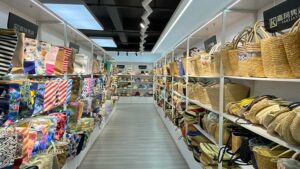
Yiwu International Trade Market: The world’s largest permanent wholesale commodity market, open year-round. Over 75,000 permanent booths across 5 districts. District 2 covers hats, bags, and accessories; District 1 covers jewelry and fashion. Visiting Yiwu allows buyers to see thousands of beach product options across hundreds of suppliers in a single trip, with on-the-spot negotiation and sample selection. Domy Beach’s showroom is in Yiwu.
Hong Kong International Sourcing Show and Global Sources exhibitions in Hong Kong: Useful intermediary step for buyers who can travel to Hong Kong but not mainland China. Suppliers tend to be more internationally oriented and often have stronger English communication capabilities.
Supplier-Direct Outreach
For buyers who have identified a specific supplier through research — whether from a platform listing, a trade show business card, or a word-of-mouth recommendation — direct outreach is the most efficient path. Send an inquiry that specifies: product category and rough description, target quantity per style, key customization requirements (materials, logo application, sizing), and your desired lead time. A well-crafted initial inquiry immediately establishes you as a serious buyer and typically yields faster, more substantive responses.
| ✓ First Inquiry Template: What to IncludeSubject: Custom [Product] Inquiry — [Your Brand Name], 200 pcs, U.S. Market. Body: Briefly introduce your brand and current sales channels. Specify the product you need. Share reference images if available. State your target quantity and delivery timeline. Ask about MOQ, lead time, sample cost, and customization options. Attach your logo if you have one. A specific, professional first message signals that you are a genuine buyer — and dramatically improves your response rate and the quality of responses you receive. |
Sourcing Agents: When They Add Value (and When They Don’t)
A China sourcing agent acts as your on-the-ground representative — finding and vetting suppliers, managing communication, conducting factory audits, overseeing production quality, and coordinating logistics. Typical agency fees range from 5-10% of order value; independent agents often charge toward the lower end. Additional services like factory audits ($200-$400) and quality inspections ($200-$400) may be billed separately.
Agents add clear value when: you are entering the Chinese market for the first time and lack local knowledge; you need to source across multiple unrelated categories simultaneously; you cannot communicate in Mandarin and require reliable translation; or you are dealing with complex product specifications that require on-site technical oversight.
Agents add less value when: you have already identified a specific high-quality supplier directly (like Domy Beach) that provides full English-language support, design services, and account management — because the agent’s primary value-add is replicated by the supplier’s own service model. Adding an agent fee on top of a full-service supplier simply increases cost.
| ⚠ The Hidden Commission ProblemA well-documented challenge in the China sourcing agent industry: many agents receive hidden commissions from the factories they recommend. When this happens, the agent’s incentive is to recommend the factory that pays the highest kickback, not the factory that is best for your product. Always ask your agent directly: ‘Do you receive any commission or rebate from the factories you recommend?’ A trustworthy agent will answer clearly and confirm their compensation model in writing. Independently verify quotes by contacting 1-2 factories directly. |
Vetting Suppliers: A Rigorous, Practical Framework
Finding a supplier is easy. Finding a supplier who will consistently deliver what they promise, at the quality level you expect, on the timeline you need — that requires real diligence. This section gives you a systematic vetting framework.
Document Verification
Before investing time in sampling, verify the basics of who you are dealing with.
Business license: Request a copy of the supplier’s Chinese business license (营业执照). Verify the registered company name, the business scope (it should include manufacturing and/or export), and the registration address. The legal company name on the license must match the bank account name when you make payment.
Export credentials: Confirm the supplier has export authority (进出口经营许可证). Not all Chinese factories are registered to export directly; some sell through licensed trading arms.
Factory vs. trading company: Compare the business license registration address with the factory address provided. Ask for the Unified Social Credit Code (统一社会信用代码) and verify it against China’s National Enterprise Credit Information System (gsxt.gov.cn) if in doubt.
Certifications: Depending on your brand’s requirements, request copies of relevant certifications: BSCI (labor compliance), ISO 9001 (quality management), OEKO-TEX Standard 100 (chemical safety), GRS (recycled content), GOTS (organic content). Verify each certificate is current — many are presented with expired dates.
Video Verification and Virtual Factory Tour
For buyers who cannot visit in person, a live video call showing the factory floor is the single highest-value verification step available. During the call:
Ask to see the production area relevant to your product (e.g., straw hat weaving floor, sewing room, quality inspection area).
Ask them to show you products similar to yours in current production or in their sample room.
Ask to speak with (or at minimum see) the person who would be your account manager.
Pay attention to the organization and cleanliness of the production floor — a chaotic, poorly organized factory is a quality risk signal.
Suppliers who refuse a video call or are consistently unavailable for one are a red flag. Every serious, legitimate supplier in 2025 has video call capability and understands why international buyers request it.
The Supplier Vetting Scorecard
| Criteria | Must Have ✔ | Good to Have ★ | Red Flag ✖ |
| Business registration | Valid business license matching company name | Manufacturing scope verified on gsxt.gov.cn | Refuses to share business license |
| Communication | Responds within 24 hours; fluent English | Dedicated English-speaking account manager | Days between responses; Google Translate only |
| Factory evidence | Factory photos or video tour on request | Live video call showing production floor | Only stock Alibaba listing images |
| Sample capability | Physical sample available before bulk order | Sample fee refunded on first bulk order | Insists on bulk order before sampling |
| Quality certifications | At least one credible cert (ISO / BSCI etc.) | Multiple current certifications with valid dates | Only self-declared quality claims, no certs |
| Payment terms | 50% deposit / 50% before shipment; company T/T | Accepts PayPal or credit card for small orders | Requests 100% upfront; personal bank accounts |
| References | Can provide prior buyer references on request | References from brands in your market segment | Refuses references; no verifiable transaction history |
| MOQ & flexibility | MOQ stated clearly; size mix allowed | MOQ under 200 pcs per style for custom | Vague MOQ; no flexibility for small brands |
Requesting and Evaluating References
Ask every shortlisted supplier for two or three references from existing international buyers, preferably from the U.S. or European market. When you contact the references, ask: How long have you worked with this supplier? Have there been quality issues, and how were they handled? Did orders arrive on the agreed timeline? Would you order again, and why or why not? Reference conversations of even 5-10 minutes provide more actionable insight than hours of email-based due diligence.
Domy Beach’s Verification Profile
| Business Entity | Yiwu Domy Garment Co., Ltd. — registered in Yiwu, Zhejiang, China |
| Physical Location | 2,000+ sqm showroom in Yiwu; open for in-person visits and video tours |
| English Support | Dedicated English-speaking 1-on-1 account manager assigned to every client |
| Sample Policy | Physical samples available pre-bulk; sample fee ($100-300) refunded on first order |
| Payment | 50% deposit + 50% before shipment; PayPal, credit card, T/T accepted |
| Product Scope | Straw hats, beach bags, fishing shirts, board shorts, accessories — full category |
| Design Service | Free 24-hour design response; no design files required from buyer |
Product Development: From Idea to Approved Sample
Product development is the most creatively demanding part of the sourcing process, and the stage where most delays originate. Understanding how it actually works — and what causes slowdowns — allows you to manage it efficiently.
The Brief: Setting Your Supplier Up to Succeed
A clear, complete design brief is the single most important thing you can do to accelerate product development and reduce revision cycles. The brief does not need to be a technical document — most beach brand buyers are not product engineers — but it does need to be specific. A good brief covers:
Product category and target use: ‘Wide-brim floppy straw hat for beach resort retail, target customer female 25-45.’
Style reference: Two or three reference images (Pinterest screenshots, competitor product photos, or sketches are all fine). Be explicit about what you want to replicate and what you want to do differently.
Material preference: Natural straw / raffia / cotton / mix? Any specific requirements (UPF, water-resistance, packability)?
Color direction: Provide Pantone references if you have them; if not, describe in clear terms (‘warm cream, not stark white; natural undyed straw’).
Key dimensions: Brim width, crown height, head circumference range. If you don’t know, say so — the supplier can propose standard dimensions.
Logo requirements: Provide your logo file (AI or high-res PNG), specify preferred placement and application method.
Packaging requirements: Individual poly bag? Custom hang tag? Inner sticker label? Gift box?
Quantity and timeline: How many pieces per style? When do you need delivery?
| ✓ Fewer words, more imagesA design brief with 3 clear reference images and 5 bullet points of specific requirements will produce better results than a 3-page written description with no visuals. Chinese suppliers work from visual references naturally; an abundance of words without images creates interpretation risk. |
Design Iteration: Realistic Expectations
Most custom product developments require 2-3 rounds of revision between initial design concept and approved sample. Common revision triggers include: color not matching the reference, logo placement slightly off, strap or hardware detail different from what was imagined, material texture different from expectation. This is normal. The key to minimizing revision cycles is to give specific, actionable feedback on each round: ‘The brim is 2cm too narrow; please increase to 12cm’ is more useful than ‘the brim doesn’t look right.’
At Domy Beach, the first design concept is returned within 24 hours of a complete brief, free of charge. Most clients complete design approval within 3-5 business days across 1-2 revision rounds.
Sample Production and Evaluation
Once the design is approved in artwork form, the supplier produces a physical sample. This typically takes 7-15 business days depending on complexity and current factory load. The sample fee (typically $50-300 for beach products) covers material and labor; at Domy Beach, this fee is fully credited toward the first bulk order.
When evaluating a physical sample, be systematic:
Measure it: Compare brim width, crown height, and head circumference against your spec. Small deviations are expected and acceptable; deviations over 5% should be corrected.
Examine construction quality: Check seam alignment, stitching consistency, and internal structure. Squeeze and release the crown — it should return to shape.
Test the brim: Wide-brim hats should hold their curve without drooping. Gently fold — good-quality straw should flex without cracking.
Assess the logo application: For embroidery, run your finger firmly over it; there should be no thread pilling or lifting. For printed logos, test color vibrancy and edge sharpness.
Check interior comfort: The sweatband should be smooth and firmly attached; no scratchy or rough surfaces.
Compare to the approved artwork: Does the physical sample match the visual mockup in proportions, color, and detail placement?
Document your approval or revision feedback in writing. This creates a reference record that protects both parties and ensures the bulk production matches the approved sample.
| ⚠ The sample-to-bulk quality gapThe most common complaint in Chinese manufacturing is that bulk production quality does not match the approved sample. This happens for two main reasons: the factory used premium materials or extra care in sample production that are not maintained at scale, or specifications were not formally documented and production staff interpreted them differently. Mitigation: (1) Always request that the supplier keep one copy of the approved sample for reference during production; (2) Document the approved spec in writing including key dimensions, material references, and logo placement; (3) For orders over $5,000, consider a mid-production quality check (see Section 8). |
Pricing, MOQ, and Negotiation
Understanding How Chinese Suppliers Price
Chinese factory pricing is not a fixed menu. Initial quotes typically include a margin for negotiation — industry knowledge suggests initial quotes can run 10-20% above the effective market rate for buyers without local price benchmarks. Understanding the components of your quote helps you negotiate intelligently:
Material cost: The primary driver. Ask the supplier what material specification was quoted. Small upgrades (e.g., heavier-weight canvas, higher-grade raffia) are worth asking about; sometimes quality goes up significantly for a modest price increase.
Labor cost: Reflects the complexity of construction. Handwoven items and complex decoration work are labor-intensive and correctly command higher prices.
Decoration cost: Logo application is typically quoted separately or as an add-on. Embroidery pricing depends on stitch count; print pricing depends on number of colors and coverage area.
Packaging cost: Individual poly bags, hangtags, and retail packaging are add-ons. Request an itemized quote if you want to understand the packaging contribution.
Supplier margin: The spread between factory cost and the price quoted to you. This is normal and not a sign of dishonesty; it funds design, sampling, account management, and business overhead.
MOQ: What’s Genuinely Negotiable
Minimum order quantities exist because factories need production runs large enough to cover setup costs (material procurement, machine setup, color mixing) efficiently. Most suppliers have a real floor below which they lose money. However, MOQs are often set conservatively and can be negotiated, particularly for:
First-time orders with a credible buyer who signals strong long-term potential
Ready-made (existing) styles where no new material procurement is needed
Multiple styles ordered simultaneously (combined MOQ across styles)
Buyers working with a supplier who explicitly positions on low-MOQ capability (like Domy Beach)
MOQs are rarely negotiable below about 50% of the stated figure without a meaningful per-unit price increase. The most effective path is to find a supplier whose genuine MOQ aligns with your order size — rather than trying to push an incompatible supplier down to your scale.
Full Cost Modeling: Landed Cost Calculation
Unit price is irrelevant without landed cost. Here is a full model for a representative beach hat order:
| Cost Component | Typical Range | Notes |
| Ex-factory unit price | $5.00 – $10.00 | Quoted price per unit at factory gate (FOB Yiwu) |
| Ocean freight (LCL/FCL) | $0.50 – $2.00 | Varies by order size, season, and route. LCL: higher per unit; FCL: lower per unit at volume |
| U.S. import duties | $1.00 – $3.50 | Estimate 15–30%+ on ex-factory value; exact rate depends on HTS code and material |
| Customs brokerage fee | $0.10 – $0.50 | Licensed broker fee; typically $150–$350 per shipment, allocated per unit |
| Drayage / last-mile | $0.10 – $0.40 | Port to your warehouse or 3PL; depends on distance and delivery format |
| Sample cost (amortized) | $0.25 – $1.00 | Sample fee ($100–$300) divided across first bulk order quantity |
| Total landed cost | $7.00 – $17.50 | All-in per unit. Use the high end of the range for your business model projections |
| ✓ The 3x Rule for Sustainable MarginsA common benchmark in wholesale beach accessories: your target retail price should be at least 3x your total landed cost for a viable wholesale margin, and 5-6x for healthy DTC (direct-to-consumer) margins. If a $6.00 landed hat will retail at $18, that’s workable. If it retails at $12, the economics are very tight unless you have exceptional volume. |
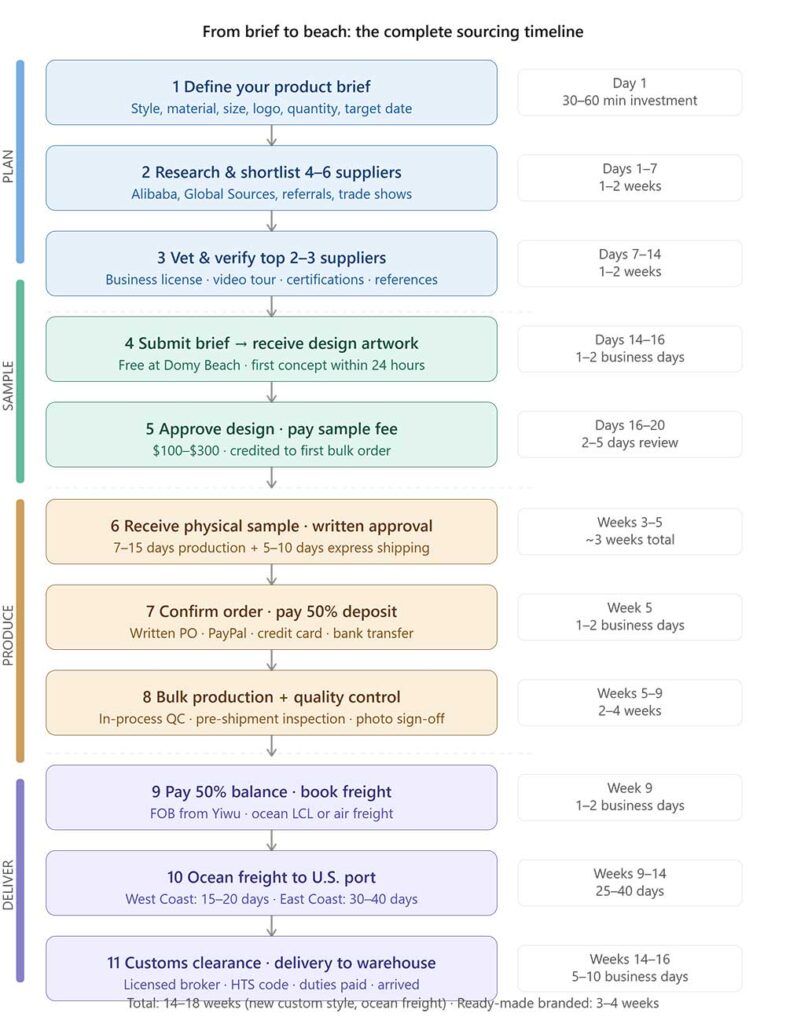
The Complete Sourcing Timeline: Stage by Stage
One of the most common and costly mistakes in beach product sourcing is underestimating the total time from first contact with a supplier to product in your U.S. warehouse. Below is a realistic, stage-by-stage breakdown.
| Stage | Timeframe | Key Action / Milestone |
| Supplier Research & Shortlisting | 1– 3 weeks | Identify 3–5 candidates; run initial contact emails; evaluate responses |
| Supplier Vetting | 1–2 weeks | Request documents; conduct video call; check certifications and references |
| Design Brief & Artwork | 1–5 business days | Submit brief; receive artwork concepts; complete design approval (1–2 revision rounds) |
| Sample Production | 7–15 business days | Factory produces physical sample; ships via express courier |
| Sample Shipping to U.S. | 5–10 days (DHL/FedEx) | Express air shipping of physical sample from China |
| Sample Review & Approval | 3–7 business days | Evaluate against spec; provide written feedback; approve or request revision |
| Order Confirmation & Deposit | 1–2 business days | Confirm order in writing; pay 50% deposit |
| Bulk Production | 2–4 weeks | Factory manufactures bulk order; internal QC; photo documentation |
| Pre-shipment Inspection (optional) | 1–2 business days | Third-party inspector or factory video inspection of finished goods |
| Balance Payment & Booking | 1–2 business days | Pay 50% balance; freight forwarder books container or LCL space |
| Ocean Freight to U.S. Port | 25–40 days | Typical West Coast (LA/Long Beach): 15–20 days; East Coast: 30–40 days |
| U.S. Customs Clearance | 3–7 business days | CBP entry, duty payment, inspection (if triggered) |
| Delivery to Your Warehouse | 2–5 business days | Drayage and final delivery |
| TOTAL (new style, ocean freight) | 14–18 weeks | Plan 4 months from first supplier contact to U.S. delivery |
| TOTAL (reorder, approved spec) | 8–10 weeks | No sample phase; faster production cycle for repeat styles |
| TOTAL (ready-made, air freight) | 3–4 weeks | Ready-to-label in-stock styles; air freight to U.S. |
| ✕ The Most Common Planning Failure: Ordering Too LateSummer beach products ordered in May will not arrive by July 4th. New custom styles ordered in March will not be on shelves before Memorial Day. U.S. buyers who consistently miss their selling season do so because they start the sourcing process too late. For custom styles targeting summer: begin supplier selection in October-November, complete sample approval by January-February, and confirm bulk production by February-March at the latest. |
Quality Control: Protecting Your Investment
Quality problems discovered at your U.S. warehouse are expensive, time-consuming, and often unrecoverable within the selling season. A well-designed quality control process catches problems early — when they can still be fixed cheaply.
The Four Quality Checkpoints
Pre-production: Confirm that the materials being used in bulk production match the approved sample spec. Ask for photos of the raw materials before cutting begins.
In-production (first-article inspection): After the first 50-100 units are produced, request photos or a video showing finished units alongside the approved sample. Defects identified at this stage can be corrected for the remaining production without complete rework.
Pre-shipment inspection (PSI): After 100% of production is complete and packed, inspect a random sample of units against the approved spec. The Acceptable Quality Level (AQL) standard is the industry benchmark: a 2.5 AQL means that for a 1,000-unit order, if more than 21 units in a random sample of 80 have major defects, the lot fails and must be reworked. Third-party inspection companies (QIMA, Bureau Veritas, SGS, Intertek) charge $200-400 per inspection and can conduct this for you in China with 48-72 hours’ notice.
On-arrival check: When goods arrive, open 5-10% of cartons randomly and compare against the approved sample and packing list. Document any discrepancies immediately — you have a very limited window to make claims against a supplier for quality issues.
When Third-Party Inspection Is Worth It
Third-party pre-shipment inspection is cost-effective for any order where the value of potential rework or replacement exceeds the $200-400 inspection fee — which is essentially any order over $2,000-3,000. For smaller orders, requesting a video inspection from the factory (showing random units pulled from sealed cartons) provides useful visibility at no additional cost. Be specific: ask to see the interior stitching, the logo application closeup, the dimensions checked with a measuring tape on camera.
Communicating Quality Standards in Writing
A quality dispute that reaches the point of legal or trade platform escalation is almost always preceded by a failure to document specifications in writing. Before bulk production begins, confirm in writing: the approved sample reference number or description, key dimensions and tolerances, material specifications, defect classification (what constitutes a major vs. minor defect for your product), AQL level, and packaging requirements. This documentation protects both parties and creates a clear reference for the factory’s production team.
Logistics, Shipping, and U.S. Customs
International freight is complex, but the core decisions are not — and understanding them in advance prevents costly last-minute surprises.
Shipping Method Selection
| Method | Transit Time | Cost Range | Best Used For |
| Express Courier (DHL/FedEx/UPS) | 5–10 days | $15–30/kg | Samples; urgent small orders under $1,500 value; time-critical replenishment |
| Standard Air Freight | 10–15 days | $6–12/kg | Small-to-mid volume orders where lead time is a priority; orders $2,000–5,000 value |
| Ocean Freight — LCL (Groupage) | 25–40 days | $0.40–1.50/kg | Bulk orders that don’t fill a full container; most beach product orders fall here |
| Ocean Freight — FCL (Full Container) | 25–40 days | Lowest per-unit | Orders filling 20ft ($3,500+) or 40ft container; larger brands and volume buyers |
Incoterms: Who Pays for What
Incoterms define the point at which responsibility and cost transfer from seller to buyer. The most common terms in beach product sourcing:
FOB (Free on Board): Seller delivers goods to the named port (e.g., FOB Yiwu, FOB Shanghai) and loads them onto the vessel. Buyer is responsible for ocean freight, insurance, and all costs from that point. This is the most common term for B2B beach product orders and gives buyers direct control over freight forwarding.
CIF (Cost, Insurance, Freight): Seller pays ocean freight and insurance to the destination port. Buyer handles import clearance and final delivery. CIF appears convenient but removes your ability to competitively shop for freight rates.
DDP (Delivered Duty Paid): Seller handles everything including import duties and final delivery to your warehouse. Maximum convenience but highest cost; the supplier’s freight and duty handling may not be optimized.
For most beach product buyers, FOB is the recommended Incoterm. It gives you direct control over freight costs and timing, and allows you to work with a preferred freight forwarder who knows your business.
U.S. Customs Essentials
Importing commercial goods into the United States requires working with a licensed customs broker for formal entries (shipments valued over $2,500). Your broker files the entry with CBP (U.S. Customs and Border Protection) and arranges duty payment. Key documentation needed:
Commercial invoice: Provided by the supplier; must include accurate product description, quantity, unit price, total value, country of origin, and buyer/seller contact information.
Packing list: Detailed breakdown of what is in each carton (item, quantity, dimensions, weight).
Bill of lading or Air Waybill: Issued by the freight carrier; proof of shipment.
HTS classification: Your broker determines the correct Harmonized Tariff Schedule code for your product. This code determines your duty rate. For beach hats, common HTS chapters include Chapter 65 (headwear) with specific subheadings by material. Bags fall under Chapter 42 (leather and travel goods) or Chapter 63 (textile articles) depending on material. Ask your broker to classify your specific product before ordering.
Country of origin documentation: Required to establish that goods genuinely originate in China (as opposed to a third country attempting to circumvent tariffs).
| ⚠ Product Description Accuracy Is Now Strictly EnforcedCBP has significantly tightened enforcement of product description accuracy since 2024. ‘Hat’ is not an acceptable description; ‘women’s wide-brim raffia straw hat, natural fiber, Chapter 6502’ is. Incorrect or vague descriptions trigger holds, additional exams, and potential penalties. Ensure your commercial invoice uses specific, accurate product descriptions and your supplier provides all required documentation. |
Cargo Consolidation: The Hidden Cost-Saver
If you source from multiple Chinese suppliers, shipping each supplier’s goods separately as individual LCL shipments is expensive and logistically complex. Cargo consolidation — routing all goods to a single Chinese warehouse before combined export — can meaningfully reduce per-unit freight cost and simplify customs clearance.
Domy Beach offers a cargo consolidation service as a standard capability: buyers sourcing from other Chinese suppliers can route those goods through Domy Beach’s Yiwu warehouse for combined export in a single shipping booking. This is particularly valuable for beach brands sourcing across multiple categories (e.g., hats and bags from Domy Beach, sunglasses from another Yiwu supplier, beach towels from a Zhejiang textile factory) who want to combine everything into one freight shipment.
Building a Long-Term Supplier Relationship
The sourcing process described in this guide is intensive because it must be — for the first order. But the most successful beach brands don’t re-run this full process every season. They invest in a supplier relationship that compounds over time: each order is faster, cheaper, and better than the last because both parties understand each other’s requirements.
What Good Supplier Relationships Look Like
Priority production scheduling: Long-term clients at suppliers like Domy Beach are prioritized in production queues during peak season — meaning your order gets scheduled ahead of first-time buyers.
Reduced MOQ over time: As your order history builds, suppliers become more willing to accommodate smaller minimum quantities for new style tests.
Design co-development: The supplier’s design team starts proactively showing you new seasonal styles before you ask. Your account manager sends you trend reports and new material arrivals that are relevant to your brand.
Streamlined reordering: For approved styles, the bulk production phase shrinks because the specification is already locked; there is no sample cycle.
Preferential pricing: Volume discounts formalize, and price increases in raw materials are absorbed or flagged far in advance.
Communication Practices That Build Trust
Be specific and documented: Every decision — design approval, production start, payment confirmation, shipping instruction — should be confirmed in writing via email or messaging. Verbal agreements are not enforceable in cross-border commerce.
Pay on time: Suppliers who receive deposits and final payments promptly prioritize those clients. Late payments create friction and can deprioritize your production.
Provide actionable feedback: When something is wrong, say specifically what is wrong and what you need corrected. ‘The quality is bad’ is not actionable. ‘The embroidery thread is pilling on 12 of the 20 units I sampled; I need this corrected with a denser stitch density in the next production’ is actionable.
Visit in person when you can: A single in-person visit to a supplier’s factory or showroom typically advances the relationship by the equivalent of 6-12 months of email communication. If you are building a business on Chinese supply, visit Yiwu at least once.
When to Re-evaluate or Diversify Your Supplier Base
Supplier relationships should be re-evaluated when: quality consistency has declined across two or more consecutive orders; lead time commitments are regularly missed without proactive communication; pricing has increased significantly without a corresponding improvement in service or materials; or your product needs have evolved beyond the supplier’s capabilities.
Diversification — maintaining relationships with two suppliers — is advisable for brands whose revenue significantly depends on a single product category. This is less relevant if your supplier already covers multiple categories (like Domy Beach), which inherently diversifies your dependency.
Working with Domy Beach: A Complete Reference
This section provides a complete operational reference for buyers working with or considering Domy Beach (Yiwu Domy Garment Co., Ltd.) as a sourcing partner.
About Domy Beach
Domy Beach is a one-stop beach product supplier headquartered in Yiwu, Zhejiang, China. The company began as a straw hat specialist and has spent over a decade evolving into a full-category beach brand supply partner. Its product ecosystem covers straw hats, beach bags (canvas, straw/raffia, waterproof, and custom styles), beach apparel (fishing shirts, board shorts, cover-ups), and beach accessories — all available for custom development or ready-to-label wholesale. The company’s 2,000+ sqm showroom in Yiwu is open to international buyers year-round and receives visitors from dozens of countries monthly.
Product Range Summary
| Straw Hats | Wide-brim floppy hats, fedoras, Panama hats, cowboy straw hats, bucket hats (natural and fabric), lifeguard hats, visors, packable travel hats — all major beach headwear styles |
| Beach Bags | Canvas open totes, zipper-top bags, natural raffia/straw woven bags, waterproof styles, drawstring bags, rope-handle bucket bags, oversized beach carry bags |
| Beach Apparel | UPF 50+ fishing shirts (long/short sleeve), board shorts, swim trunks, casual beach cover-ups; full print or logo-only customization |
| Accessories | Sun visors, beach jewelry, beach towels, hat accessories; seasonal range updated annually |
| Ready-Made MOQ | From 50 pieces per style (catalog styles with logo branding) |
| Custom MOQ | From 100 pieces per style for most custom developments; some specialty materials 200 pcs |
| Design Service | Free; 24-hour turnaround from receipt of complete brief; no client artwork files required |
| Sample Fee | $100–$300 depending on complexity; fully credited against first bulk order |
Step-by-Step: How to Place Your First Order
Contact Domy Beach via domybeach.com (inquiry form) or WhatsApp to introduce your brand and request a product catalog.
A dedicated English-speaking account manager is assigned and sends a full digital catalog within 24 hours.
Browse the catalog and identify styles of interest, OR describe your custom product requirements and reference images.
Your account manager returns design artwork within 24 hours of a complete brief, free of charge.
Review the artwork, request any revisions (typically 1-2 rounds), and provide written design approval.
Pay the sample fee ($100-300). The physical sample ships to you via DHL/FedEx, arriving in 5-10 business days.
Evaluate the sample against this guide’s checklist. Provide written approval or specific revision requests.
Confirm the bulk order in writing (quantity, styles, packaging, delivery address). Pay the 50% deposit.
Bulk production begins (2-4 weeks). Your account manager provides production photo updates on request.
Pre-shipment QC is completed. Your account manager notifies you of completion with photos.
Pay the 50% balance. Freight is booked (ocean or air based on your timeline). Cargo departs.
Tracking is shared. Goods arrive at U.S. port. Your customs broker files the entry.
Goods are delivered to your warehouse. Review on-arrival against the approved spec.
Cargo Consolidation Service
If you are sourcing from other Chinese suppliers in addition to Domy Beach, you can route all goods to Domy Beach’s Yiwu warehouse for combined export. Contact your account manager to arrange this before other suppliers’ production is complete. Domy Beach coordinates inbound receipt, inspection, combined packing, and freight booking for all consolidated goods.
The 10 Most Expensive Mistakes Buyers Make Sourcing from China
Most sourcing failures are predictable — and preventable. This section documents the mistakes that cost buyers the most, drawn from the recurring patterns in how first-time and early-stage Chinese sourcing relationships go wrong.
| Mistake | How to Avoid It |
| Treating the first quote as the final price | Request quotes from at least 2-3 suppliers on identical specs. Chinese manufacturers price against perceived alternatives. Competition produces better pricing. |
| Skipping the sample stage to save time or money | The sample is your only opportunity to catch problems before committing hundreds of dollars to bulk production. A $150 sample that reveals a misalignment saves thousands in bulk rejects. |
| Ordering too much on the first run of an unproven product | Start with the minimum viable quantity. Use the first order to validate market demand, not to optimize unit economics. |
| Choosing on unit price alone without calculating landed cost | Add freight ($0.50-2.00/unit), duty (15-30%+ of ex-factory), and brokerage ($0.10-0.50/unit) before comparing suppliers. The cheapest ex-factory quote often becomes the most expensive landed cost. |
| Starting the sourcing process too late for the season | Custom beach products require 14-18 weeks from first contact to U.S. delivery. Ready-made branded styles require 3-4 weeks. Plan your season backwards from your target sell date. |
| Not documenting the approved specification in writing | Every quality dispute that escalates originates from an undocumented specification. Document the approved sample, key dimensions, material, logo placement, and AQL level before bulk production begins. |
| Failing to verify the supplier is the actual manufacturer | Trading companies misrepresent as factories regularly. Request a business license, factory address, and video tour. The address on the license should match the factory location. |
| Accepting verbal timelines without written confirmation | Production and shipping timelines must be confirmed in writing. A supplier who agrees verbally to a 3-week production timeline but delivers in 6 weeks has no written obligation. Email confirmation creates accountability. |
| Working without a licensed customs broker | Import classification errors, inaccurate descriptions, and missing documentation can trigger holds, fines, and delayed deliveries. A $200-350 customs brokerage fee is one of the most cost-effective investments in your supply chain. |
| Neglecting the supplier relationship after the first order | The best pricing, MOQ flexibility, production priority, and design collaboration come from long-term relationships. Treat your supplier as a partner, not a transaction. Timely payment, specific feedback, and consistent volume create the conditions for a relationship that compounds. |
FREQUENTLY ASKED QUESTIONS
The Sourcing Process
Q1. I’ve never sourced from China before. What’s the single most important thing to do first?
Define your product clearly before you contact any supplier. ‘I want a beach hat’ will produce generic quotes and slow responses. ‘I want a natural raffia wide-brim hat, 12cm brim, cream color, small embroidered logo on the crown, 100 pieces, for a U.S. resort retailer’ will produce fast, specific, comparable quotes. The quality of your initial brief directly predicts the quality of your sourcing experience. Spend 30-60 minutes on it before sending your first inquiry.
Q2. How do I know if I’m talking to the factory or a trading company, and does it matter?
It matters because trading companies typically add 15-30% to factory pricing and have less direct control over production quality and lead times. To determine which you’re dealing with: request a copy of their business license and compare the registered business scope — manufacturing companies list ‘production’ or ‘manufacturing’ in their scope, while trading companies list ‘import/export trade.’ Also request a factory address and ask for a video tour of the production floor. If they can’t or won’t show you a production area, you’re likely dealing with a trading company.
Q3. How many suppliers should I approach, and how do I narrow the list?
For a typical beach product order, approach 4-6 suppliers initially and narrow to 2-3 for sampling. Evaluation criteria for narrowing: (1) Response speed and quality — suppliers who reply within 24 hours with specific, relevant answers demonstrate operational competence; (2) Product catalog fit — does their range genuinely cover what you need, or are they stretching? (3) MOQ compatibility — does their minimum align with your order size?; (4) Communication fluency — are they easy to work with at this stage? The sampling stage will tell you everything about product quality; the initial contact stage tells you about their service culture.
Q4. What should my first order look like — what quantity, how many styles, what products?
For a first custom beach product order, we recommend: 1-3 styles maximum, at the minimum available quantity per style, with the highest-priority product in your range. This limits financial exposure, compresses your sample evaluation complexity, and gets real market feedback quickly. Resist the temptation to order everything at once. A focused first order that sells out will teach you more than a broad first order that moves slowly.
Q5. How do I handle the language barrier when working with Chinese suppliers?
The language barrier is much smaller than most U.S. buyers expect, particularly with established suppliers oriented toward international clients. At Domy Beach and other top-tier suppliers, English-speaking account managers handle all communication. Key practices to reduce miscommunication regardless: use images rather than lengthy written descriptions; confirm key decisions (design approvals, production specs, timelines) in writing via email; avoid idioms and highly colloquial language in written communication; and don’t assume silence means agreement — ask for explicit confirmation.
Products, Quality & Design
Q6. What is UPF 50+ and how do I verify that my beach hats or fishing shirts actually meet this standard?
UPF (Ultraviolet Protection Factor) measures how much UV radiation a fabric blocks. A UPF 50+ rating means the fabric blocks at least 98% of UV radiation. For beach hats and fishing shirts, UPF 50+ is a meaningful selling point with U.S. consumers, particularly for outdoor and fishing lifestyle brands. Verification: the material itself needs to be tested by an accredited lab (AATCC 183 is the relevant U.S. test standard). Request the test report from your supplier; a legitimate UPF claim must reference a specific test report number. Do not accept a supplier’s verbal claim of UPF 50+ without documentary evidence of testing.
Q7. What materials should I prioritize for U.S. beach hat buyers in 2025?
Natural straw materials continue to dominate premium beach hat sales in the U.S. The strongest performing materials in 2025: natural raffia (premium positioning, durable, beautiful drape), paper straw (accessible price point, good visual appeal, widely available), cotton-linen blends (softer feel, good for structured bucket hats and casual styles), and toyo (pressed paper straw, very clean surface, good for logo embroidery). Avoid heavily synthetic materials for anything positioned as a premium beach product — U.S. consumers are increasingly material-aware and will notice. If sustainability is part of your brand story, organic cotton, RPET recycled fiber, and certified natural materials are all available from suppliers like Domy Beach.
Q8. Can I provide my own fabric or material for custom production?
It is technically possible but rarely practical or cost-effective. Chinese factories have established material supplier relationships that are optimized for their production processes. Buyer-supplied materials often cause: delays (the factory needs to test the material in their process), quality issues (the material may not behave as expected), and higher costs (the factory loses their material margin and adds a handling fee). The better approach: describe your material requirements clearly in your brief, and let the factory source the matching material from their supplier network. For very specific sustainability certifications (GRS, GOTS), supply certified material specifications and ask the factory to source accordingly.
Q9. How do I protect my designs from being copied and sold to other buyers?
Intellectual property protection in Chinese manufacturing is a legitimate concern. Practical protections: (1) Sign an NDA (Non-Disclosure Agreement) with your supplier before sharing designs; reputable suppliers will sign without hesitation; (2) Work with established, verified suppliers with long track records — IP theft is disproportionately a risk with smaller, less scrupulous operators; (3) Register your logo and distinctive product designs as trademarks and/or design patents in the U.S. (USPTO) before launching; this gives you legal recourse if designs are replicated; (4) Don’t share your full product roadmap or multi-season strategy with a supplier on a first order. Build trust before sharing long-range plans.
Q10. What logo application method is best for a straw beach hat?
The right method depends on your logo’s complexity and the hat’s material. For straw hats specifically: embroidery is the gold standard — it looks premium, is durable, and works on virtually all straw materials. Woven labels (sewn-in or sewn-on) are excellent for inside the crown brim. Heat-transfer or printed labels work on smoother woven straw surfaces but should be tested on samples before committing. Avoid screen printing directly on rough straw surfaces — the irregular texture prevents clean adhesion. For the brim’s underside (common placement), an embroidered or printed canvas ribbon works beautifully.
Costs, MOQ & Timelines
Q11. I have a small budget (under $2,000). Is it realistic to start sourcing from China?
Yes — but structure your first order appropriately. At Domy Beach, a first ready-made branded order of 50 wide-brim straw hats with embroidered logo starts at approximately $350-500 for the product plus $50-150 for sample evaluation, plus air freight ($150-250 to the U.S.). Total first order investment: roughly $600-900 landed. This is a completely viable test of your market at minimal risk. The key is choosing ready-made (existing design, logo added) rather than fully custom for your first order — it eliminates the sample production phase and delivers the fastest, most affordable proof of concept.
Q12. Why is the sample fee so important, and is it really worth paying?
The sample fee is the most valuable $100-300 you will spend in your sourcing process. It is the only opportunity to physically evaluate your product before committing potentially thousands of dollars to bulk production. Consider the alternative: skipping the sample to save time or $150, then receiving 200 units where the brim is 3cm narrower than you wanted, the embroidery thread color is wrong, and the material feels cheaper than expected. Reworking or replacing 200 units costs many times the sample fee. At Domy Beach, the sample fee is fully credited against your first bulk order, making the net cost effectively zero if you proceed.
Q13. My competitor seems to have a very similar product to what I’m developing. Should I be worried about price parity?
Product parity in beach accessories is common — the designs available from Chinese suppliers are not exclusive unless you develop fully original custom styles. What differentiates brands in this space is not the product design alone but the total package: branding, packaging, storytelling, customer experience, and pricing strategy. Your branded custom straw hat from Domy Beach and your competitor’s similar hat from another supplier are both good hats. The brand that invests in photography, packaging, positioning, and consistent quality wins the customer relationship. The most durable competitive advantage in beach products comes from brand equity, not design exclusivity at the base product level.
Q14. How much does it cost to import 300 beach hats from China to the U.S.? Can you give a realistic example?
Example scenario: 300 custom natural raffia wide-brim hats (ex-factory $7.50 each). Ex-factory total: $2,250. Ocean freight (LCL from Yiwu to Los Angeles, approx. 0.5 CBM): $180-280. U.S. import duty at approximately 20% of ex-factory: $450. Customs brokerage: $200. Drayage from port to warehouse: $100-150. Total landed cost: approximately $3,180-3,350, or about $10.60-11.17 per unit. At a typical 4x landed cost wholesale price, that’s $42-45 per hat. At a 5x DTC retail price, $53-56. This is a very viable margin structure for a branded beach hat brand.
Logistics & Compliance
Q15. What is an HTS code and how do I find the right one for my beach products?
An HTS (Harmonized Tariff Schedule) code is a 10-digit number that classifies your product for U.S. customs purposes. It determines your import duty rate. Beach product HTS code guidance: straw hats and beach headwear generally fall under Chapter 65 (Headgear), with subheadings by material and construction (e.g., 6502.00.60 for unfinished hat forms; 6504.00.30 for braided/woven natural fiber hats; 6505.00.90 for other textile hats). Beach bags fall under Chapter 42 or 63 depending on outer material. The correct classification is product-specific; your licensed customs broker will determine the right code for your specific product based on the commercial invoice description and material composition. Incorrect classification is a compliance risk.
Q16. Do I need a freight forwarder, or can I handle shipping myself?
For commercial beach product imports into the U.S., a licensed freight forwarder and customs broker are both strongly recommended. The freight forwarder books cargo space, coordinates logistics, and manages documentation. The customs broker files the entry with CBP, classifies your product, and arranges duty payment. For small first orders below $2,500 in value, some buyers use informal import methods (having goods shipped as a personal import), but this is not appropriate for commercial resale inventory and creates compliance exposure. Freight forwarders and customs brokers charge $200-400 combined for a typical commercial shipment — a small fraction of your order value and well worth the compliance protection.
Q17. Can I ship beach products from China directly to an Amazon FBA fulfillment center?
Yes, with the right preparation. Amazon FBA has specific requirements: individual units must be in polybags or boxes, each with a scannable FNSKU barcode (Amazon’s own label), and cartons must meet Amazon’s size and labeling standards. Arrange FBA prep with your Chinese supplier before production is complete: provide the FNSKU barcode file, specify polybag requirements, and confirm carton dimensions meet Amazon’s current requirements (check Amazon Seller Central for current FBA requirements, as they are updated periodically). Your freight forwarder handles U.S. customs clearance and delivery to the FBA warehouse. Ensure your customs entry reflects the correct HTS code and value — FBA shipments go through the same CBP process as any commercial import.
Working with Domy Beach
Q18. I want to order beach hats AND fishing shirts from Domy Beach. Can these be in one order and one shipment?
Yes — this is one of the primary benefits of working with a one-stop supplier. A single order can include any combination of straw hats, beach bags, fishing shirts, board shorts, and accessories. Your account manager coordinates the production timeline across all product categories, ensuring they are ready for consolidated shipping. There is no additional charge for combining categories. The consolidated shipment enters the U.S. on a single Bill of Lading, simplifying your customs clearance. Note that different product categories have different HTS classifications; ensure your commercial invoice itemizes each product category separately with its own description and value.
Q19. What happens if Domy Beach cannot fulfill my order due to production issues or capacity constraints?
As a professional supplier relationship, this scenario should be addressed proactively in your initial conversations. Ask your account manager: what is the current lead time for your target products? What is the factory capacity utilization in your order window? For critical season orders, we recommend confirming production start dates in writing and requesting production photos at the midpoint of the manufacturing timeline. If production issues arise, Domy Beach’s account manager model means you have a named contact responsible for proactively communicating any changes. As with any supplier relationship, transparent communication works both ways: inform your supplier of hard delivery deadlines upfront so they can plan accordingly.
Q20. I’ve read this entire guide. What’s the one-sentence summary of how to source custom beach products from China successfully?
Start with a clear brief, choose a supplier whose genuine capabilities match your order scale, never skip the sample, calculate landed cost not unit price, give yourself more lead time than you think you need — and invest in the relationship, because the biggest returns in sourcing from China come not from the first order but from the fifth.