
L'approvvigionamento di prodotti da spiaggia personalizzati dalla Cina è una delle decisioni più strategiche che un marchio di abbigliamento da spiaggia in crescita possa prendere. Se fatto bene, permette di accedere a una produzione di livello mondiale, prezzi competitivi e una differenziazione del prodotto impossibile da ottenere con l'approvvigionamento nazionale o con piattaforme di vendita all'ingrosso generiche. Se fatto male, invece, può causare ritardi nelle spedizioni, prodotti di qualità inferiore, specifiche non comunicate correttamente e capitale immobilizzato in scorte invendibili.
Questa guida si basa su un principio fondamentale: l'informazione elimina gran parte del rischio. Gli acquirenti che si trovano in difficoltà acquistando dalla Cina sono per lo più persone alla prima esperienza che hanno agito sulla base di informazioni incomplete, senza sapere quali domande porre, quali segnali di allarme cercare o come funziona effettivamente il processo, dal brief iniziale alla consegna. Questa guida colma tali lacune.
Copriamo ogni fase del processo di approvvigionamento, dalla definizione del prodotto e dalla comprensione del panorama manifatturiero cinese, alla ricerca e selezione dei fornitori, alla gestione della campionatura e della produzione, alla gestione della logistica e delle procedure doganali statunitensi, fino alla costruzione di un rapporto di fiducia con i fornitori che si consolidi nel tempo. In ogni fase, basiamo la nostra consulenza sulle specifiche realtà del settore dei prodotti da spiaggia: cappelli di paglia, borse da spiaggia, camicie da pesca, pantaloncini da surf e accessori.
Nel corso di questa guida, facciamo riferimento Spiaggia Domy (Yiwu Domy Garment Co., Ltd., domybeach.com) come esempio di fornitore. Domy Beach è un fornitore completo di prodotti da spiaggia con sede a Yiwu, in Cina, che offre cappelli di paglia, borse da spiaggia e abbigliamento da spiaggia, con possibilità di personalizzazione a partire da 100 pezzi e prodotti pronti all'uso a partire da 50 pezzi. Laddove le politiche o i processi specifici di Domy Beach illustrino un concetto più generale, li indichiamo chiaramente. Il nostro obiettivo è fornire una guida pratica, non una presentazione di vendita.
Perché la Cina? Le ragioni a sostegno della sua posizione di leader mondiale nella produzione di articoli da spiaggia.
Prima di investire tempo nel processo di approvvigionamento, è importante capire esattamente perché la Cina domina questo settore e perché è probabile che tale dominio persista nel 2025 e negli anni successivi.
Profondità del cluster manifatturiero
La produzione di articoli da spiaggia in Cina non è distribuita uniformemente su tutto il territorio nazionale. È concentrata in un numero limitato di distretti altamente specializzati, dove l'intera catena di approvvigionamento – materie prime, fornitori di componenti, manodopera qualificata, logistica per l'esportazione e servizi commerciali – coesiste nel raggio di pochi chilometri. I distretti più importanti per gli acquirenti statunitensi di articoli da spiaggia sono:
Yiwu, Zhejiang: il più grande mercato al mondo di piccoli articoli e uno dei centri di approvvigionamento più prolifici a livello globale per cappelli di paglia e accessori da spiaggia. È qui che ha sede Domy Beach. L'ecosistema unico della città, con decine di migliaia di fornitori, un mercato dedicato al commercio internazionale e una consolidata infrastruttura di spedizioni, la rendono la destinazione di approvvigionamento più pratica e centralizzata per i marchi di abbigliamento da spiaggia che creano collezioni multi-categoria.
Qingdao, Shandong: Un importante centro per la produzione su larga scala di cappelli di paglia e di fibre naturali. Sede di alcune delle più grandi fabbriche di cappelli in Cina in termini di volume di produzione.
Guangzhou e Shenzhen, Guangdong: centri di eccellenza per cappelli strutturati, copricapi ricamati su misura e accessori moda. Punti di forza per gli acquirenti che necessitano di lavorazioni decorative complesse o che si riforniscono insieme a prodotti elettronici o articoli promozionali.
Baoding, Hebei: storicamente importante per la produzione di cappelli e sede ancora oggi di diverse aziende esportatrici affermate.
Questa struttura a cluster significa che quando si acquistano prodotti da spiaggia dalla Cina, soprattutto da Yiwu, non si acquista da una singola fabbrica. Si accede a un intero ecosistema di fornitori di materiali, fornitori di finiture, produttori di imballaggi e partner logistici che, insieme, rendono possibile una produzione personalizzata rapida, conveniente e di alta qualità.
I vantaggi competitivi che contano davvero
Ampia gamma di prodotti: nessun altro paese offre contemporaneamente cappelli di paglia personalizzati, borse da spiaggia intrecciate, abbigliamento da spiaggia e accessori con qualità, velocità e prezzo paragonabili.
Velocità di progettazione e campionatura: un fornitore cinese competente con un team di progettazione interno può fornire una prima bozza di design entro 24-48 ore e un campione fisico entro 7-15 giorni. Questa velocità di produzione è semplicemente ineguagliabile altrove.
Flessibilità del MOQ: i fornitori cinesi, in particolare a Yiwu, hanno investito molto nel servire i piccoli acquirenti internazionali. Quantitativi minimi d'ordine (MOQ) di 50-100 pezzi sono effettivamente raggiungibili per i prodotti di marca già pronti; 100-200 pezzi per la maggior parte dei modelli personalizzati. Questa situazione non è tipica della produzione in Vietnam, Bangladesh o India.
Rapporto qualità-prezzo: un cappello di paglia personalizzato di alta qualità, prodotto in Cina, può essere acquistato a un prezzo compreso tra $4 e 12 centesimi franco fabbrica, a seconda della complessità e del volume. Un prodotto equivalente, reperito negli Stati Uniti, costerebbe molto di più e avrebbe tempi di consegna più lunghi.
La realtà tariffaria del 2025: una valutazione onesta
Le tensioni commerciali tra Stati Uniti e Cina hanno esercitato una notevole pressione sui costi di importazione dei prodotti da spiaggia. L'attuale regime tariffario per la maggior parte delle categorie di cappelli e borse da spiaggia provenienti dalla Cina combina l'aliquota base MFN (Nazione più favorita), i dazi previsti dalla Sezione 301 imposti dal 2018 e qualsiasi altra imposta aggiuntiva. L'aliquota effettiva cumulativa su cappelli e borse da spiaggia provenienti dalla Cina si attesta generalmente tra 15 e 30%+, a seconda dello specifico codice HTS (Sistema Armonizzato di Tariffazione) e della composizione del materiale.
Si tratta di una pressione sui costi reale che deve essere considerata nel modello dei costi di acquisizione. Tuttavia, tre considerazioni aiutano a inquadrarla nella giusta prospettiva:
L'approvvigionamento da paesi alternativi non ha eliminato il problema. Il Vietnam e il Bangladesh si trovano ad affrontare una crescente esposizione ai dazi doganali, e nessuno dei due possiede la stessa capacità produttiva della Cina per i prodotti da spiaggia, consentendo lo sviluppo di prodotti personalizzati con quantitativi minimi d'ordine ridotti.
Il dazio doganale si applica al prezzo franco fabbrica, non al prezzo di vendita al dettaglio. Considerando i ricarichi tipici dei marchi di abbigliamento da spiaggia (da 3 a 5 volte il costo di sbarco), l'impatto del dazio sul margine di profitto è gestibile se considerato fin dall'inizio, anziché essere scoperto solo al momento dello sdoganamento.
Le importazioni commerciali B2B di grandi dimensioni godono ora di un vantaggio strutturale. L'eliminazione dell'esenzione de minimis $800 per le merci cinesi (in vigore da maggio 2025) ha penalizzato i modelli di vendita diretta al consumatore per piccoli pacchi (Temu, Shein), ma non ha avuto un impatto significativo sul modello di importazione all'ingrosso utilizzato dagli acquirenti professionisti di marchi di abbigliamento da spiaggia.
| ✓ Calcola sempre il costo totale, non il prezzo unitario.Il costo unitario effettivo include: prezzo franco fabbrica + trasporto + dazi doganali statunitensi + spese di sdoganamento + consegna dell'ultimo miglio. Per un tipico cappello da spiaggia proveniente dalla Cina e spedito via mare, dazi e trasporto combinati spesso aggiungono 1,50-4,00 dollari per unità al prezzo di fabbrica. È importante includere questo costo nel modello di prezzo prima, e non dopo, aver confermato l'ordine. |
Categorie di prodotti da spiaggia: cosa si può reperire dalla Cina
Comprendere cosa producono effettivamente i produttori cinesi e come il processo di approvvigionamento differisce a seconda della categoria di prodotto, evita aspettative errate e perdite di tempo.
Cappelli di paglia e cappelli da spiaggia
Cosa è disponibile
La Cina produce l'intera gamma di copricapi da spiaggia: cappelli a tesa larga e flosci, cappelli Panama, fedora di paglia, cappelli da cowboy di paglia, cappelli a secchiello in materiali naturali e tessili, visiere, cappelli da bagnino e cappelli da viaggio pieghevoli. Sono ampiamente prodotti sia modelli in fibre naturali (rafia, paglia di carta, paglia di grano, erba marina, bambù) che modelli sintetici/in materiali misti.
Cosa determina il costo?
Materiale: la rafia naturale e l'erba toquilla di alta qualità hanno un prezzo superiore rispetto alla paglia di carta e alla fibra sintetica intrecciata.
Larghezza della tesa: le tese più larghe (12 cm e oltre) richiedono più materiale e un maggiore impegno nella modellatura, aumentando i costi.
Complessità costruttiva: i modelli interamente tessuti a mano costano di più rispetto a quelli tessuti a macchina; il rinforzo della tesa e la struttura interna ne aumentano il costo.
Decorazione: Ricami, loghi a trasferimento termico, etichette tessute e toppe hanno costi e quantitativi minimi differenti.
Fascia di prezzo tipica franco fabbrica
Cappello da spiaggia base in paglia di carta, ricamo del logo: $3.50 – $6.00 per 200 pezzi
Cappello a tesa larga in rafia naturale di media qualità: $5.50 – $10.00 per 200 pezzi
Cappello in toquilla pregiata tessuta a mano o in rafia di alta qualità: $9.00 – $18.00 per 200 pezzi
Borse da spiaggia
Cosa è disponibile
In Cina, la categoria delle borse da spiaggia comprende: borse a tracolla in tela aperte, borse in tela con cerniera, borse intrecciate in paglia naturale e rafia, borse impermeabili in PVC o poliestere, borse a rete, borse con coulisse, borse a secchiello con manici in corda, borse in juta e borse da spiaggia di grandi dimensioni. Sono disponibili sia modelli preconfezionati di produzione di massa che design completamente personalizzati.
Cosa determina il costo?
Materiale: la paglia naturale e la rafia sono in genere più costose della tela o del poliestere a parità di dimensioni.
Costruzione: basi rinforzate, fodere impermeabili, chiusure a cerniera e tasche interne comportano costi aggiuntivi.
Componenti metallici: anelli di bambù, chiusure a levetta in legno, fermagli in metallo e manici in corda incidono significativamente sul costo rispetto ai semplici manici in tessuto.
Dimensioni: Le borse tote di grandi dimensioni richiedono una quantità di materiale notevolmente maggiore rispetto alle dimensioni standard.
Fascia di prezzo tipica franco fabbrica
Borsa tote standard in tela aperta, 38x40 cm, stampa logo: $2.50 – $5.50 per 300 pezzi
Borsa tote in rafia naturale intrecciata, misura media: $4.50 – $9.00 per 200 pezzi
Borsa da spiaggia premium di grandi dimensioni, fodera impermeabile, manici in bambù: $8.00 – $16.00 per 200 pezzi
Abbigliamento da spiaggia (camicie da pesca, pantaloncini da surf, copricostume)
Cosa è disponibile
Le province cinesi del Guangdong, del Fujian e del Jiangsu ospitano la più grande concentrazione al mondo di produttori di abbigliamento. Per quanto riguarda l'abbigliamento specifico per la spiaggia, le categorie principali includono: magliette da pesca con protezione solare UPF 50+ (a maniche lunghe e corte), pantaloncini da surf e costumi da bagno, copricostume, magliette protettive anti-UV e abbigliamento casual da resort.
Cosa determina il costo?
Specifiche del tessuto: i tessuti tecnici (poliestere UPF, miscele ad asciugatura rapida) costano di più rispetto al cotone o al policotone standard.
Complessità di stampa: la stampa a sublimazione su tutta la superficie comporta costi aggiuntivi rispetto alla decorazione con solo il logo.
Dettagli costruttivi: tasche con cerniera, elastico in vita con coulisse, fodera in rete nei pantaloncini, tutti elementi che incidono sul prezzo.
Certificazione: i test e la documentazione di certificazione UPF 50+ comportano un piccolo sovrapprezzo per ogni modello.
Fascia di prezzo tipica franco fabbrica
Pantaloncini da surf basic, ricamo o stampa del logo, poliestere: $5.00 – $9.00 per 100 pezzi
Maglia da pesca a maniche lunghe UPF 50+: $7.00 – $14.00 per 100 pezzi
Maglietta da pesca premium con stampa a sublimazione, design a copertura totale: $10.00 – $18.00 per 100 pezzi
Che cosa significa "sportello unico" e perché è importante.
La maggior parte degli acquirenti che si riforniscono dalla Cina gestisce più fornitori per diverse categorie di prodotti. Se il vostro marchio di abbigliamento da spiaggia ha bisogno di cappelli, borse e abbigliamento, la procedura standard prevede di trovare una fabbrica di cappelli, una fabbrica di borse e una fabbrica di abbigliamento, gestendo di conseguenza tre rapporti con fornitori indipendenti, tre processi di campionatura separati, tre spedizioni separate e tre standard di qualità differenti.
Fornitori unici come Domy Beach eliminano questa frammentazione. Un singolo ordine può includere cappelli di paglia, borse da spiaggia e camicie da pesca, Gestita da un unico account manager, la merce viene spedita con un'unica prenotazione di trasporto consolidata. Per i marchi che creano collezioni stagionali coerenti, questa integrazione non è solo comoda, ma garantisce anche uniformità nella gamma di materiali, coerenza del design visivo e riduce drasticamente la complessità operativa.
| ★ Domey Beach: una copertura completa in praticaDomy Beach offre cappelli di paglia, borse da spiaggia, abbigliamento da spiaggia (magliette da pesca, pantaloncini da surf) e accessori, tutto da un'unica sede a Yiwu. Ordine minimo a partire da 50 pezzi (prodotti pronti) e 100 pezzi (personalizzati). Tutte le categorie sono disponibili per la personalizzazione completa o con etichetta pronta. Servizio di progettazione gratuito entro 24 ore. Gli ordini di tutte le categorie possono essere consolidati in un'unica spedizione. |
Trovare fornitori: canali, compromessi e ciò che funziona davvero
La prima domanda che ogni nuovo acquirente si pone è: dove posso trovare i fornitori? La domanda più importante è: qual è il canale più adatto alla mia situazione e al mio profilo di ordini?
Piattaforme di approvvigionamento online
Le piattaforme B2B online rappresentano il punto di partenza predefinito per la maggior parte degli acquirenti. Le tre principali piattaforme rilevanti per l'approvvigionamento di prodotti da spiaggia sono:
Alibaba: il più grande per volume, con la più ampia rete di fornitori. La sfida principale è distinguere i produttori autentici dalle società commerciali che rivendono i prodotti con margini di profitto maggiorati. Lo status di produttore verificato (badge Fornitore Oro, report di audit di fabbrica) è utile ma non decisivo. Il programma Trade Assurance di Alibaba offre una certa protezione dei pagamenti, ma non garantisce la qualità del prodotto.
Global Sources: si concentra maggiormente su fabbriche verificate e acquirenti con volumi di acquisto più elevati. La verifica dei fornitori tende ad essere più rigorosa rispetto alle informazioni autodichiarate da Alibaba. È un punto di forza per le categorie di prodotti strutturati, ma offre una copertura minore per i prodotti artigianali in fibre naturali.
Made-in-China.com: Posizionamento simile a Global Sources; buona fonte di verifica secondaria e utile per confrontare le informazioni sui fornitori trovate su Alibaba.
Protocollo pratico per la ricerca di piattaforme: (1) Eseguire ricerche di prodotti utilizzando termini specifici (ad esempio, "cappello da spiaggia in rafia personalizzato OEM Yiwu" invece di semplicemente "cappello da spiaggia"); (2) Filtrare per fornitore Gold / stato verificato; (3) Controllare la cronologia delle transazioni e le recensioni degli acquirenti; (4) Confrontare lo stesso fornitore su più piattaforme per ottenere un quadro più completo; (5) Considerare la lista iniziale come punto di partenza per la comunicazione diretta, non come decisione finale.
| ⚠ Società commerciale contro fabbrica: la distinzione crucialeMolti fornitori elencati come "produttori" su Alibaba sono in realtà società commerciali, ovvero intermediari che si riforniscono dalle fabbriche e aggiungono un margine di profitto. Le società commerciali non sono di per sé negative, ma in genere aggiungono un ricarico (15-30%) ai prezzi di fabbrica e potrebbero avere meno controllo sulla qualità e sui tempi di consegna. Per verificare: richiedete foto della fabbrica, immagini della linea di produzione e l'indirizzo fisico della fabbrica. Richiedete una videochiamata che mostri l'area di produzione. Chiedete la licenza commerciale e verificate l'attività registrata. La licenza di una vera fabbrica indicherà "produzione" nell'ambito di attività registrato; una società commerciale indicherà "commercio" o "import/export".‘ |
Fiere commerciali e approvvigionamento di persona
Per gli acquirenti che possono investire nell'approvvigionamento di persona, le fiere e le visite di mercato offrono una qualità delle informazioni che nessuna piattaforma online può eguagliare. Gli eventi e le località chiave di interesse per gli acquirenti di prodotti da spiaggia sono:
Fiera di Canton (Fiera cinese di importazione ed esportazione), Guangzhou: Si tiene due volte l'anno (aprile-maggio e ottobre-novembre) ed è la più grande fiera commerciale al mondo per numero di espositori. La Fase 1 (elettronica/beni industriali), la Fase 2 (beni di consumo, inclusi borse e valigie) e la Fase 3 (tessile e abbigliamento) sono tutte rilevanti per gli acquirenti di prodotti da spiaggia. Visitare la fiera per 2-3 giorni permette di valutare da 50 a 100 fornitori, avendo a disposizione campioni fisici dei prodotti.
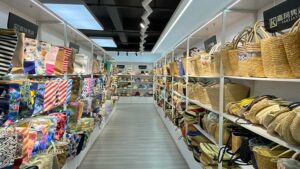
Mercato Internazionale di Yiwu: il più grande mercato all'ingrosso permanente al mondo, aperto tutto l'anno. Oltre 75.000 stand permanenti distribuiti in 5 distretti. Il Distretto 2 è dedicato a cappelli, borse e accessori; il Distretto 1 a gioielli e abbigliamento. Visitare Yiwu permette agli acquirenti di visionare migliaia di prodotti da spiaggia offerti da centinaia di fornitori in un unico viaggio, con possibilità di negoziazione immediata e selezione di campioni. Lo showroom di Domy Beach si trova a Yiwu.
Le fiere Hong Kong International Sourcing Show e Global Sources di Hong Kong rappresentano un utile passaggio intermedio per gli acquirenti che possono recarsi a Hong Kong ma non nella Cina continentale. I fornitori tendono ad avere un orientamento più internazionale e spesso vantano una migliore conoscenza della lingua inglese.
Contatto diretto con i fornitori
Per gli acquirenti che hanno individuato un fornitore specifico tramite ricerche (che si tratti di un elenco su una piattaforma, di un biglietto da visita a una fiera o di una raccomandazione), il contatto diretto è la strada più efficace. Inviate una richiesta specificando: categoria di prodotto e una descrizione generale, quantità desiderata per modello, requisiti di personalizzazione principali (materiali, applicazione del logo, taglie) e tempi di consegna desiderati. Una richiesta iniziale ben formulata vi presenta immediatamente come un acquirente serio e in genere genera risposte più rapide e complete.
| ✓ Modello per la prima richiesta di informazioni: cosa includereOggetto: Richiesta di personalizzazione [Prodotto] — [Nome del tuo marchio], 200 pezzi, mercato statunitense. Corpo del messaggio: Presenta brevemente il tuo marchio e i canali di vendita attuali. Specifica il prodotto di cui hai bisogno. Condividi immagini di riferimento, se disponibili. Indica la quantità desiderata e i tempi di consegna. Chiedi informazioni su MOQ, tempi di consegna, costo del campione e opzioni di personalizzazione. Allega il tuo logo, se ne hai uno. Un primo messaggio specifico e professionale segnala che sei un acquirente serio e migliora notevolmente il tasso di risposta e la qualità delle risposte che ricevi. |
Agenti di approvvigionamento: quando aggiungono valore (e quando non lo fanno)
Un agente di approvvigionamento in Cina funge da vostro rappresentante sul campo, individuando e selezionando i fornitori, gestendo la comunicazione, conducendo audit di fabbrica, supervisionando la qualità della produzione e coordinando la logistica. Le commissioni tipiche di un'agenzia variano dal 5% al 10% del valore dell'ordine; gli agenti indipendenti spesso applicano tariffe più basse. Servizi aggiuntivi come audit di fabbrica (1-100%) e controlli di qualità (1-100%) possono essere fatturati separatamente.
Gli agenti apportano un valore aggiunto evidente quando: si entra per la prima volta nel mercato cinese e non si ha familiarità con il mercato locale; è necessario reperire contemporaneamente prodotti appartenenti a diverse categorie non correlate; non si è in grado di comunicare in mandarino e si necessita di un servizio di traduzione affidabile; oppure si ha a che fare con specifiche di prodotto complesse che richiedono una supervisione tecnica in loco.
L'intervento di un agente apporta meno valore quando: hai già individuato direttamente un fornitore specifico di alta qualità (come Domy Beach) che offre supporto completo in lingua inglese, servizi di progettazione e gestione dell'account, perché il principale valore aggiunto dell'agente è replicato dal modello di servizio del fornitore stesso. Aggiungere una commissione all'agente, oltre al servizio completo offerto dal fornitore, non fa altro che aumentare i costi.
| ⚠ Il problema delle commissioni nascosteUn problema ben documentato nel settore degli agenti di approvvigionamento in Cina è che molti agenti ricevono commissioni occulte dalle fabbriche che raccomandano. In questi casi, l'incentivo per l'agente è quello di raccomandare la fabbrica che paga la commissione più alta, non quella più adatta al vostro prodotto. Chiedete sempre direttamente al vostro agente: "Ricevete commissioni o sconti dalle fabbriche che raccomandate?". Un agente affidabile risponderà chiaramente e confermerà per iscritto il proprio modello di remunerazione. Verificate autonomamente i preventivi contattando direttamente 1-2 fabbriche. |
Valutazione dei fornitori: un quadro di riferimento rigoroso e pratico
Trovare un fornitore è facile. Trovare un fornitore che mantenga sempre le promesse, con la qualità che vi aspettate e nei tempi previsti, questo sì che richiede un'attenta valutazione. Questa sezione vi offre un quadro di riferimento sistematico per la selezione dei fornitori.
Verifica dei documenti
Prima di dedicare tempo al campionamento, verificate le informazioni di base su chi avete di fronte.
Licenza commerciale: Richiedete una copia della licenza commerciale cinese del fornitore (营业执照). Verificate la ragione sociale registrata, l'ambito di attività (che dovrebbe includere la produzione e/o l'esportazione) e l'indirizzo di registrazione. La ragione sociale riportata sulla licenza deve corrispondere al nome del conto bancario utilizzato per effettuare il pagamento.
Credenziali di esportazione: conferma che il fornitore dispone dell'autorità di esportazione (进出口经营许可证). Non tutte le fabbriche cinesi sono registrate per esportare direttamente; alcuni vendono tramite bracci commerciali autorizzati.
Stabilimento o società commerciale: confrontate l'indirizzo di registrazione della licenza commerciale con l'indirizzo dello stabilimento fornito. Richiedete il Codice Unificato di Credito Sociale (统一社会信用代码) e, in caso di dubbi, verificatelo tramite il Sistema Nazionale Cinese di Informazione sul Credito delle Imprese (gsxt.gov.cn).
Certificazioni: In base ai requisiti del tuo marchio, richiedi copie delle certificazioni pertinenti: BSCI (conformità alle normative sul lavoro), ISO 9001 (gestione della qualità), OEKO-TEX Standard 100 (sicurezza chimica), GRS (contenuto riciclato), GOTS (contenuto biologico). Verifica che ogni certificato sia valido: molti vengono presentati con date di scadenza.
Verifica video e tour virtuale della fabbrica
Per gli acquirenti che non possono recarsi di persona in azienda, una videochiamata in diretta che mostri lo stabilimento di produzione rappresenta la procedura di verifica più efficace disponibile. Durante la chiamata:
Chiedi di poter visitare l'area di produzione relativa al tuo prodotto (ad esempio, il reparto di tessitura dei cappelli di paglia, la sala cucito, l'area di controllo qualità).
Chiedi loro di mostrarti prodotti simili ai tuoi, attualmente in produzione o presenti nella loro sala campioni.
Chiedi di parlare (o quantomeno di vedere) la persona che sarà il tuo responsabile di account.
Presta attenzione all'organizzazione e alla pulizia dell'area di produzione: una fabbrica caotica e mal organizzata è un segnale di rischio per la qualità.
I fornitori che rifiutano una videochiamata o che sono costantemente irreperibili per una videochiamata rappresentano un campanello d'allarme. Nel 2025, ogni fornitore serio e affidabile sarà in grado di effettuare videochiamate e comprenderà perché gli acquirenti internazionali le richiedono.
Scheda di valutazione della verifica dei fornitori
| criteri | Da avere assolutamente ✔ | Buono da avere ★ | Bandiera rossa ✖ |
| Registrazione dell'attività commerciale | Licenza commerciale valida corrispondente al nome dell'azienda | Ambito di produzione verificato su gsxt.gov.cn | Si rifiuta di condividere la licenza commerciale |
| Comunicazione | Risponde entro 24 ore; parla inglese fluentemente. | Responsabile clienti dedicato che parla inglese | Giorni tra le risposte; solo Google Traduttore |
| Prove di fabbrica | Foto o video tour dello stabilimento disponibili su richiesta. | Videochiamata in diretta che mostra il reparto di produzione | Solo immagini di repertorio degli annunci Alibaba. |
| Capacità di campionamento | Campione fisico disponibile prima dell'ordine all'ingrosso. | Il costo del campione verrà rimborsato al primo ordine all'ingrosso. | Insiste sull'ordine all'ingrosso prima di prelevare i campioni. |
| Certificazioni di qualità | Almeno una certificazione credibile (ISO / BSCI ecc.) | Multiple current certifications with valid dates | Only self-declared quality claims, no certs |
| Payment terms | 50% deposit / 50% before shipment; company T/T | Accepts PayPal or credit card for small orders | Requests 100% upfront; personal bank accounts |
| References | Can provide prior buyer references on request | References from brands in your market segment | Refuses references; no verifiable transaction history |
| MOQ & flexibility | MOQ stated clearly; size mix allowed | MOQ under 200 pcs per style for custom | Vague MOQ; no flexibility for small brands |
Requesting and Evaluating References
Ask every shortlisted supplier for two or three references from existing international buyers, preferably from the U.S. or European market. When you contact the references, ask: How long have you worked with this supplier? Have there been quality issues, and how were they handled? Did orders arrive on the agreed timeline? Would you order again, and why or why not? Reference conversations of even 5-10 minutes provide more actionable insight than hours of email-based due diligence.
Domy Beach’s Verification Profile
| Business Entity | Yiwu Domy Garment Co., Ltd. — registered in Yiwu, Zhejiang, China |
| Physical Location | 2,000+ sqm showroom in Yiwu; open for in-person visits and video tours |
| English Support | Dedicated English-speaking 1-on-1 account manager assigned to every client |
| Sample Policy | Physical samples available pre-bulk; sample fee ($100-300) refunded on first order |
| Pagamento | 50% deposit + 50% before shipment; PayPal, credit card, T/T accepted |
| Product Scope | Straw hats, beach bags, fishing shirts, board shorts, accessories — full category |
| Servizio di progettazione | Free 24-hour design response; no design files required from buyer |
Product Development: From Idea to Approved Sample
Product development is the most creatively demanding part of the sourcing process, and the stage where most delays originate. Understanding how it actually works — and what causes slowdowns — allows you to manage it efficiently.
The Brief: Setting Your Supplier Up to Succeed
A clear, complete design brief is the single most important thing you can do to accelerate product development and reduce revision cycles. The brief does not need to be a technical document — most beach brand buyers are not product engineers — but it does need to be specific. A good brief covers:
Product category and target use: ‘Wide-brim floppy straw hat for beach resort retail, target customer female 25-45.’
Style reference: Two or three reference images (Pinterest screenshots, competitor product photos, or sketches are all fine). Be explicit about what you want to replicate and what you want to do differently.
Material preference: Natural straw / raffia / cotton / mix? Any specific requirements (UPF, water-resistance, packability)?
Color direction: Provide Pantone references if you have them; if not, describe in clear terms (‘warm cream, not stark white; natural undyed straw’).
Key dimensions: Brim width, crown height, head circumference range. If you don’t know, say so — the supplier can propose standard dimensions.
Logo requirements: Provide your logo file (AI or high-res PNG), specify preferred placement and application method.
Packaging requirements: Individual poly bag? Custom hang tag? Inner sticker label? Gift box?
Quantity and timeline: How many pieces per style? When do you need delivery?
| ✓ Fewer words, more imagesA design brief with 3 clear reference images and 5 bullet points of specific requirements will produce better results than a 3-page written description with no visuals. Chinese suppliers work from visual references naturally; an abundance of words without images creates interpretation risk. |
Design Iteration: Realistic Expectations
Most custom product developments require 2-3 rounds of revision between initial design concept and approved sample. Common revision triggers include: color not matching the reference, logo placement slightly off, strap or hardware detail different from what was imagined, material texture different from expectation. This is normal. The key to minimizing revision cycles is to give specific, actionable feedback on each round: ‘The brim is 2cm too narrow; please increase to 12cm’ is more useful than ‘the brim doesn’t look right.’
At Domy Beach, the first design concept is returned within 24 hours of a complete brief, free of charge. Most clients complete design approval within 3-5 business days across 1-2 revision rounds.
Sample Production and Evaluation
Once the design is approved in artwork form, the supplier produces a physical sample. This typically takes 7-15 business days depending on complexity and current factory load. The sample fee (typically $50-300 for beach products) covers material and labor; at Domy Beach, this fee is fully credited toward the first bulk order.
When evaluating a physical sample, be systematic:
Measure it: Compare brim width, crown height, and head circumference against your spec. Small deviations are expected and acceptable; deviations over 5% should be corrected.
Examine construction quality: Check seam alignment, stitching consistency, and internal structure. Squeeze and release the crown — it should return to shape.
Test the brim: Wide-brim hats should hold their curve without drooping. Gently fold — good-quality straw should flex without cracking.
Assess the logo application: For embroidery, run your finger firmly over it; there should be no thread pilling or lifting. For printed logos, test color vibrancy and edge sharpness.
Check interior comfort: The sweatband should be smooth and firmly attached; no scratchy or rough surfaces.
Compare to the approved artwork: Does the physical sample match the visual mockup in proportions, color, and detail placement?
Document your approval or revision feedback in writing. This creates a reference record that protects both parties and ensures the bulk production matches the approved sample.
| ⚠ The sample-to-bulk quality gapThe most common complaint in Chinese manufacturing is that bulk production quality does not match the approved sample. This happens for two main reasons: the factory used premium materials or extra care in sample production that are not maintained at scale, or specifications were not formally documented and production staff interpreted them differently. Mitigation: (1) Always request that the supplier keep one copy of the approved sample for reference during production; (2) Document the approved spec in writing including key dimensions, material references, and logo placement; (3) For orders over $5,000, consider a mid-production quality check (see Section 8). |
Pricing, MOQ, and Negotiation
Understanding How Chinese Suppliers Price
Chinese factory pricing is not a fixed menu. Initial quotes typically include a margin for negotiation — industry knowledge suggests initial quotes can run 10-20% above the effective market rate for buyers without local price benchmarks. Understanding the components of your quote helps you negotiate intelligently:
Material cost: The primary driver. Ask the supplier what material specification was quoted. Small upgrades (e.g., heavier-weight canvas, higher-grade raffia) are worth asking about; sometimes quality goes up significantly for a modest price increase.
Labor cost: Reflects the complexity of construction. Handwoven items and complex decoration work are labor-intensive and correctly command higher prices.
Decoration cost: Logo application is typically quoted separately or as an add-on. Embroidery pricing depends on stitch count; print pricing depends on number of colors and coverage area.
Packaging cost: Individual poly bags, hangtags, and retail packaging are add-ons. Request an itemized quote if you want to understand the packaging contribution.
Supplier margin: The spread between factory cost and the price quoted to you. This is normal and not a sign of dishonesty; it funds design, sampling, account management, and business overhead.
MOQ: What’s Genuinely Negotiable
Minimum order quantities exist because factories need production runs large enough to cover setup costs (material procurement, machine setup, color mixing) efficiently. Most suppliers have a real floor below which they lose money. However, MOQs are often set conservatively and can be negotiated, particularly for:
First-time orders with a credible buyer who signals strong long-term potential
Ready-made (existing) styles where no new material procurement is needed
Multiple styles ordered simultaneously (combined MOQ across styles)
Buyers working with a supplier who explicitly positions on low-MOQ capability (like Domy Beach)
MOQs are rarely negotiable below about 50% of the stated figure without a meaningful per-unit price increase. The most effective path is to find a supplier whose genuine MOQ aligns with your order size — rather than trying to push an incompatible supplier down to your scale.
Full Cost Modeling: Landed Cost Calculation
Unit price is irrelevant without landed cost. Here is a full model for a representative beach hat order:
| Componente di costo | Typical Range | Note |
| Ex-factory unit price | $5.00 – $10.00 | Quoted price per unit at factory gate (FOB Yiwu) |
| Ocean freight (LCL/FCL) | $0.50 – $2.00 | Varies by order size, season, and route. LCL: higher per unit; FCL: lower per unit at volume |
| U.S. import duties | $1.00 – $3.50 | Estimate 15–30%+ on ex-factory value; exact rate depends on HTS code and material |
| Customs brokerage fee | $0.10 – $0.50 | Licensed broker fee; typically $150–$350 per shipment, allocated per unit |
| Drayage / last-mile | $0.10 – $0.40 | Port to your warehouse or 3PL; depends on distance and delivery format |
| Sample cost (amortized) | $0.25 – $1.00 | Sample fee ($100–$300) divided across first bulk order quantity |
| Total landed cost | $7.00 – $17.50 | All-in per unit. Use the high end of the range for your business model projections |
| ✓ The 3x Rule for Sustainable MarginsA common benchmark in wholesale beach accessories: your target retail price should be at least 3x your total landed cost for a viable wholesale margin, and 5-6x for healthy DTC (direct-to-consumer) margins. If a $6.00 landed hat will retail at $18, that’s workable. If it retails at $12, the economics are very tight unless you have exceptional volume. |
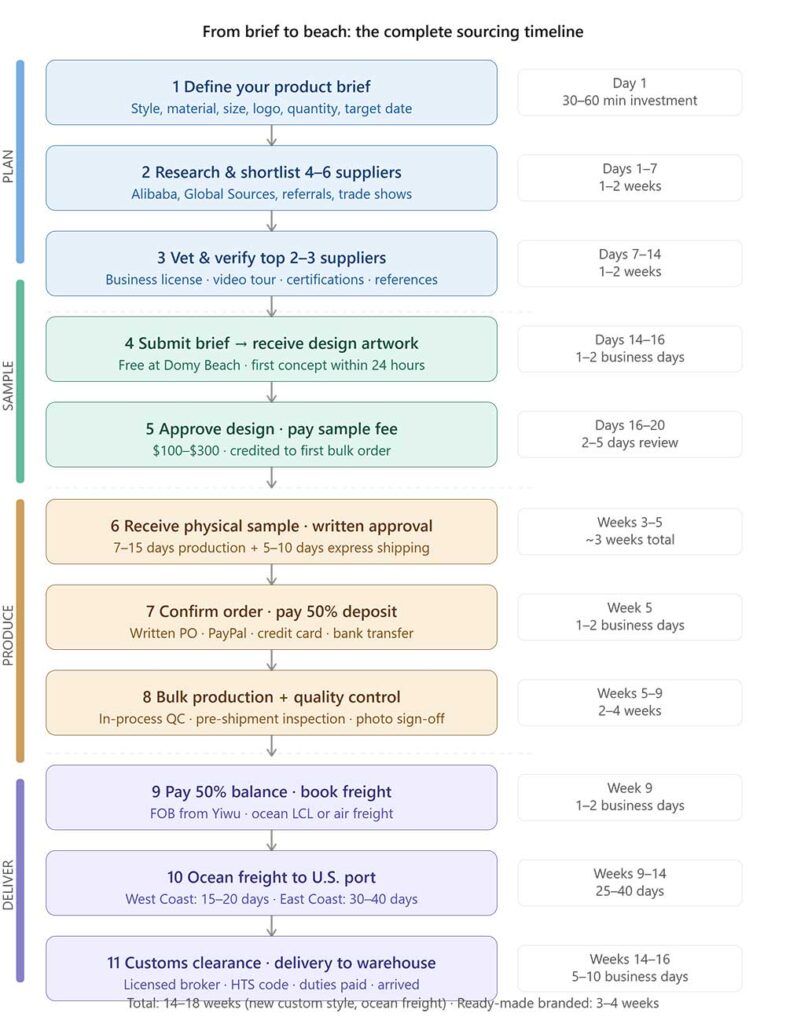
The Complete Sourcing Timeline: Stage by Stage
One of the most common and costly mistakes in beach product sourcing is underestimating the total time from first contact with a supplier to product in your U.S. warehouse. Below is a realistic, stage-by-stage breakdown.
| Stage | Tempistica | Key Action / Milestone |
| Supplier Research & Shortlisting | 1– 3 weeks | Identify 3–5 candidates; run initial contact emails; evaluate responses |
| Supplier Vetting | 1–2 weeks | Request documents; conduct video call; check certifications and references |
| Design Brief & Artwork | 1–5 business days | Submit brief; receive artwork concepts; complete design approval (1–2 revision rounds) |
| Sample Production | 7–15 business days | Factory produces physical sample; ships via express courier |
| Sample Shipping to U.S. | 5–10 days (DHL/FedEx) | Express air shipping of physical sample from China |
| Sample Review & Approval | 3–7 business days | Evaluate against spec; provide written feedback; approve or request revision |
| Order Confirmation & Deposit | 1–2 business days | Confirm order in writing; pay 50% deposit |
| Bulk Production | 2–4 weeks | Factory manufactures bulk order; internal QC; photo documentation |
| Pre-shipment Inspection (optional) | 1–2 business days | Third-party inspector or factory video inspection of finished goods |
| Balance Payment & Booking | 1–2 business days | Pay 50% balance; freight forwarder books container or LCL space |
| Ocean Freight to U.S. Port | 25–40 days | Typical West Coast (LA/Long Beach): 15–20 days; East Coast: 30–40 days |
| U.S. Customs Clearance | 3–7 business days | CBP entry, duty payment, inspection (if triggered) |
| Delivery to Your Warehouse | 2–5 business days | Drayage and final delivery |
| TOTAL (new style, ocean freight) | 14–18 weeks | Plan 4 months from first supplier contact to U.S. delivery |
| TOTAL (reorder, approved spec) | 8–10 weeks | No sample phase; faster production cycle for repeat styles |
| TOTAL (ready-made, air freight) | 3–4 weeks | Ready-to-label in-stock styles; air freight to U.S. |
| ✕ The Most Common Planning Failure: Ordering Too LateSummer beach products ordered in May will not arrive by July 4th. New custom styles ordered in March will not be on shelves before Memorial Day. U.S. buyers who consistently miss their selling season do so because they start the sourcing process too late. For custom styles targeting summer: begin supplier selection in October-November, complete sample approval by January-February, and confirm bulk production by February-March at the latest. |
Quality Control: Protecting Your Investment
Quality problems discovered at your U.S. warehouse are expensive, time-consuming, and often unrecoverable within the selling season. A well-designed quality control process catches problems early — when they can still be fixed cheaply.
The Four Quality Checkpoints
Pre-production: Confirm that the materials being used in bulk production match the approved sample spec. Ask for photos of the raw materials before cutting begins.
In-production (first-article inspection): After the first 50-100 units are produced, request photos or a video showing finished units alongside the approved sample. Defects identified at this stage can be corrected for the remaining production without complete rework.
Pre-shipment inspection (PSI): After 100% of production is complete and packed, inspect a random sample of units against the approved spec. The Acceptable Quality Level (AQL) standard is the industry benchmark: a 2.5 AQL means that for a 1,000-unit order, if more than 21 units in a random sample of 80 have major defects, the lot fails and must be reworked. Third-party inspection companies (QIMA, Bureau Veritas, SGS, Intertek) charge $200-400 per inspection and can conduct this for you in China with 48-72 hours’ notice.
On-arrival check: When goods arrive, open 5-10% of cartons randomly and compare against the approved sample and packing list. Document any discrepancies immediately — you have a very limited window to make claims against a supplier for quality issues.
When Third-Party Inspection Is Worth It
Third-party pre-shipment inspection is cost-effective for any order where the value of potential rework or replacement exceeds the $200-400 inspection fee — which is essentially any order over $2,000-3,000. For smaller orders, requesting a video inspection from the factory (showing random units pulled from sealed cartons) provides useful visibility at no additional cost. Be specific: ask to see the interior stitching, the logo application closeup, the dimensions checked with a measuring tape on camera.
Communicating Quality Standards in Writing
A quality dispute that reaches the point of legal or trade platform escalation is almost always preceded by a failure to document specifications in writing. Before bulk production begins, confirm in writing: the approved sample reference number or description, key dimensions and tolerances, material specifications, defect classification (what constitutes a major vs. minor defect for your product), AQL level, and packaging requirements. This documentation protects both parties and creates a clear reference for the factory’s production team.
Logistics, Shipping, and U.S. Customs
International freight is complex, but the core decisions are not — and understanding them in advance prevents costly last-minute surprises.
Shipping Method Selection
| Method | Transit Time | Cost Range | Best Used For |
| Express Courier (DHL/FedEx/UPS) | 5–10 days | $15–30/kg | Samples; urgent small orders under $1,500 value; time-critical replenishment |
| Standard Air Freight | 10–15 days | $6–12/kg | Small-to-mid volume orders where lead time is a priority; orders $2,000–5,000 value |
| Ocean Freight — LCL (Groupage) | 25–40 days | $0.40–1.50/kg | Bulk orders that don’t fill a full container; most beach product orders fall here |
| Ocean Freight — FCL (Full Container) | 25–40 days | Lowest per-unit | Orders filling 20ft ($3,500+) or 40ft container; larger brands and volume buyers |
Incoterms: Who Pays for What
Incoterms define the point at which responsibility and cost transfer from seller to buyer. The most common terms in beach product sourcing:
FOB (Free on Board): Seller delivers goods to the named port (e.g., FOB Yiwu, FOB Shanghai) and loads them onto the vessel. Buyer is responsible for ocean freight, insurance, and all costs from that point. This is the most common term for B2B beach product orders and gives buyers direct control over freight forwarding.
CIF (Cost, Insurance, Freight): Seller pays ocean freight and insurance to the destination port. Buyer handles import clearance and final delivery. CIF appears convenient but removes your ability to competitively shop for freight rates.
DDP (Delivered Duty Paid): Seller handles everything including import duties and final delivery to your warehouse. Maximum convenience but highest cost; the supplier’s freight and duty handling may not be optimized.
For most beach product buyers, FOB is the recommended Incoterm. It gives you direct control over freight costs and timing, and allows you to work with a preferred freight forwarder who knows your business.
U.S. Customs Essentials
Importing commercial goods into the United States requires working with a licensed customs broker for formal entries (shipments valued over $2,500). Your broker files the entry with CBP (U.S. Customs and Border Protection) and arranges duty payment. Key documentation needed:
Commercial invoice: Provided by the supplier; must include accurate product description, quantity, unit price, total value, country of origin, and buyer/seller contact information.
Packing list: Detailed breakdown of what is in each carton (item, quantity, dimensions, weight).
Bill of lading or Air Waybill: Issued by the freight carrier; proof of shipment.
HTS classification: Your broker determines the correct Harmonized Tariff Schedule code for your product. This code determines your duty rate. For beach hats, common HTS chapters include Chapter 65 (headwear) with specific subheadings by material. Bags fall under Chapter 42 (leather and travel goods) or Chapter 63 (textile articles) depending on material. Ask your broker to classify your specific product before ordering.
Country of origin documentation: Required to establish that goods genuinely originate in China (as opposed to a third country attempting to circumvent tariffs).
| ⚠ Product Description Accuracy Is Now Strictly EnforcedCBP has significantly tightened enforcement of product description accuracy since 2024. ‘Hat’ is not an acceptable description; ‘women’s wide-brim raffia straw hat, natural fiber, Chapter 6502’ is. Incorrect or vague descriptions trigger holds, additional exams, and potential penalties. Ensure your commercial invoice uses specific, accurate product descriptions and your supplier provides all required documentation. |
Cargo Consolidation: The Hidden Cost-Saver
If you source from multiple Chinese suppliers, shipping each supplier’s goods separately as individual LCL shipments is expensive and logistically complex. Cargo consolidation — routing all goods to a single Chinese warehouse before combined export — can meaningfully reduce per-unit freight cost and simplify customs clearance.
Domy Beach offers a cargo consolidation service as a standard capability: buyers sourcing from other Chinese suppliers can route those goods through Domy Beach’s Yiwu warehouse for combined export in a single shipping booking. This is particularly valuable for beach brands sourcing across multiple categories (e.g., hats and bags from Domy Beach, sunglasses from another Yiwu supplier, beach towels from a Zhejiang textile factory) who want to combine everything into one freight shipment.
Building a Long-Term Supplier Relationship
The sourcing process described in this guide is intensive because it must be — for the first order. But the most successful beach brands don’t re-run this full process every season. They invest in a supplier relationship that compounds over time: each order is faster, cheaper, and better than the last because both parties understand each other’s requirements.
What Good Supplier Relationships Look Like
Priority production scheduling: Long-term clients at suppliers like Domy Beach are prioritized in production queues during peak season — meaning your order gets scheduled ahead of first-time buyers.
Reduced MOQ over time: As your order history builds, suppliers become more willing to accommodate smaller minimum quantities for new style tests.
Design co-development: The supplier’s design team starts proactively showing you new seasonal styles before you ask. Your account manager sends you trend reports and new material arrivals that are relevant to your brand.
Streamlined reordering: For approved styles, the bulk production phase shrinks because the specification is already locked; there is no sample cycle.
Preferential pricing: Volume discounts formalize, and price increases in raw materials are absorbed or flagged far in advance.
Communication Practices That Build Trust
Be specific and documented: Every decision — design approval, production start, payment confirmation, shipping instruction — should be confirmed in writing via email or messaging. Verbal agreements are not enforceable in cross-border commerce.
Pay on time: Suppliers who receive deposits and final payments promptly prioritize those clients. Late payments create friction and can deprioritize your production.
Provide actionable feedback: When something is wrong, say specifically what is wrong and what you need corrected. ‘The quality is bad’ is not actionable. ‘The embroidery thread is pilling on 12 of the 20 units I sampled; I need this corrected with a denser stitch density in the next production’ is actionable.
Visit in person when you can: A single in-person visit to a supplier’s factory or showroom typically advances the relationship by the equivalent of 6-12 months of email communication. If you are building a business on Chinese supply, visit Yiwu at least once.
When to Re-evaluate or Diversify Your Supplier Base
Supplier relationships should be re-evaluated when: quality consistency has declined across two or more consecutive orders; lead time commitments are regularly missed without proactive communication; pricing has increased significantly without a corresponding improvement in service or materials; or your product needs have evolved beyond the supplier’s capabilities.
Diversification — maintaining relationships with two suppliers — is advisable for brands whose revenue significantly depends on a single product category. This is less relevant if your supplier already covers multiple categories (like Domy Beach), which inherently diversifies your dependency.
Working with Domy Beach: A Complete Reference
This section provides a complete operational reference for buyers working with or considering Domy Beach (Yiwu Domy Garment Co., Ltd.) as a sourcing partner.
Informazioni su Domey Beach
Domy Beach is a one-stop beach product supplier headquartered in Yiwu, Zhejiang, China. The company began as a straw hat specialist and has spent over a decade evolving into a full-category beach brand supply partner. Its product ecosystem covers straw hats, beach bags (canvas, straw/raffia, waterproof, and custom styles), beach apparel (fishing shirts, board shorts, cover-ups), and beach accessories — all available for custom development or ready-to-label wholesale. The company’s 2,000+ sqm showroom in Yiwu is open to international buyers year-round and receives visitors from dozens of countries monthly.
Product Range Summary
| Straw Hats | Wide-brim floppy hats, fedoras, Panama hats, cowboy straw hats, bucket hats (natural and fabric), lifeguard hats, visors, packable travel hats — all major beach headwear styles |
| Borse da spiaggia | Canvas open totes, zipper-top bags, natural raffia/straw woven bags, waterproof styles, drawstring bags, rope-handle bucket bags, oversized beach carry bags |
| Beach Apparel | UPF 50+ fishing shirts (long/short sleeve), board shorts, swim trunks, casual beach cover-ups; full print or logo-only customization |
| Accessories | Sun visors, beach jewelry, beach towels, hat accessories; seasonal range updated annually |
| Ready-Made MOQ | From 50 pieces per style (catalog styles with logo branding) |
| Quantità minima d'ordine personalizzata | From 100 pieces per style for most custom developments; some specialty materials 200 pcs |
| Servizio di progettazione | Free; 24-hour turnaround from receipt of complete brief; no client artwork files required |
| Sample Fee | $100–$300 depending on complexity; fully credited against first bulk order |
Step-by-Step: How to Place Your First Order
Contact Domy Beach via domybeach.com (inquiry form) or WhatsApp to introduce your brand and request a product catalog.
A dedicated English-speaking account manager is assigned and sends a full digital catalog within 24 hours.
Browse the catalog and identify styles of interest, OR describe your custom product requirements and reference images.
Your account manager returns design artwork within 24 hours of a complete brief, free of charge.
Review the artwork, request any revisions (typically 1-2 rounds), and provide written design approval.
Pay the sample fee ($100-300). The physical sample ships to you via DHL/FedEx, arriving in 5-10 business days.
Evaluate the sample against this guide’s checklist. Provide written approval or specific revision requests.
Confirm the bulk order in writing (quantity, styles, packaging, delivery address). Pay the 50% deposit.
Bulk production begins (2-4 weeks). Your account manager provides production photo updates on request.
Pre-shipment QC is completed. Your account manager notifies you of completion with photos.
Pay the 50% balance. Freight is booked (ocean or air based on your timeline). Cargo departs.
Tracking is shared. Goods arrive at U.S. port. Your customs broker files the entry.
Goods are delivered to your warehouse. Review on-arrival against the approved spec.
Cargo Consolidation Service
If you are sourcing from other Chinese suppliers in addition to Domy Beach, you can route all goods to Domy Beach’s Yiwu warehouse for combined export. Contact your account manager to arrange this before other suppliers’ production is complete. Domy Beach coordinates inbound receipt, inspection, combined packing, and freight booking for all consolidated goods.
The 10 Most Expensive Mistakes Buyers Make Sourcing from China
Most sourcing failures are predictable — and preventable. This section documents the mistakes that cost buyers the most, drawn from the recurring patterns in how first-time and early-stage Chinese sourcing relationships go wrong.
| Mistake | How to Avoid It |
| Treating the first quote as the final price | Request quotes from at least 2-3 suppliers on identical specs. Chinese manufacturers price against perceived alternatives. Competition produces better pricing. |
| Skipping the sample stage to save time or money | The sample is your only opportunity to catch problems before committing hundreds of dollars to bulk production. A $150 sample that reveals a misalignment saves thousands in bulk rejects. |
| Ordering too much on the first run of an unproven product | Start with the minimum viable quantity. Use the first order to validate market demand, not to optimize unit economics. |
| Choosing on unit price alone without calculating landed cost | Add freight ($0.50-2.00/unit), duty (15-30%+ of ex-factory), and brokerage ($0.10-0.50/unit) before comparing suppliers. The cheapest ex-factory quote often becomes the most expensive landed cost. |
| Starting the sourcing process too late for the season | Custom beach products require 14-18 weeks from first contact to U.S. delivery. Ready-made branded styles require 3-4 weeks. Plan your season backwards from your target sell date. |
| Not documenting the approved specification in writing | Every quality dispute that escalates originates from an undocumented specification. Document the approved sample, key dimensions, material, logo placement, and AQL level before bulk production begins. |
| Failing to verify the supplier is the actual manufacturer | Trading companies misrepresent as factories regularly. Request a business license, factory address, and video tour. The address on the license should match the factory location. |
| Accepting verbal timelines without written confirmation | Production and shipping timelines must be confirmed in writing. A supplier who agrees verbally to a 3-week production timeline but delivers in 6 weeks has no written obligation. Email confirmation creates accountability. |
| Working without a licensed customs broker | Import classification errors, inaccurate descriptions, and missing documentation can trigger holds, fines, and delayed deliveries. A $200-350 customs brokerage fee is one of the most cost-effective investments in your supply chain. |
| Neglecting the supplier relationship after the first order | The best pricing, MOQ flexibility, production priority, and design collaboration come from long-term relationships. Treat your supplier as a partner, not a transaction. Timely payment, specific feedback, and consistent volume create the conditions for a relationship that compounds. |
DOMANDE FREQUENTI
The Sourcing Process
Q1. I’ve never sourced from China before. What’s the single most important thing to do first?
Define your product clearly before you contact any supplier. ‘I want a beach hat’ will produce generic quotes and slow responses. ‘I want a natural raffia wide-brim hat, 12cm brim, cream color, small embroidered logo on the crown, 100 pieces, for a U.S. resort retailer’ will produce fast, specific, comparable quotes. The quality of your initial brief directly predicts the quality of your sourcing experience. Spend 30-60 minutes on it before sending your first inquiry.
Q2. How do I know if I’m talking to the factory or a trading company, and does it matter?
It matters because trading companies typically add 15-30% to factory pricing and have less direct control over production quality and lead times. To determine which you’re dealing with: request a copy of their business license and compare the registered business scope — manufacturing companies list ‘production’ or ‘manufacturing’ in their scope, while trading companies list ‘import/export trade.’ Also request a factory address and ask for a video tour of the production floor. If they can’t or won’t show you a production area, you’re likely dealing with a trading company.
Q3. How many suppliers should I approach, and how do I narrow the list?
For a typical beach product order, approach 4-6 suppliers initially and narrow to 2-3 for sampling. Evaluation criteria for narrowing: (1) Response speed and quality — suppliers who reply within 24 hours with specific, relevant answers demonstrate operational competence; (2) Product catalog fit — does their range genuinely cover what you need, or are they stretching? (3) MOQ compatibility — does their minimum align with your order size?; (4) Communication fluency — are they easy to work with at this stage? The sampling stage will tell you everything about product quality; the initial contact stage tells you about their service culture.
Q4. What should my first order look like — what quantity, how many styles, what products?
For a first custom beach product order, we recommend: 1-3 styles maximum, at the minimum available quantity per style, with the highest-priority product in your range. This limits financial exposure, compresses your sample evaluation complexity, and gets real market feedback quickly. Resist the temptation to order everything at once. A focused first order that sells out will teach you more than a broad first order that moves slowly.
Q5. How do I handle the language barrier when working with Chinese suppliers?
The language barrier is much smaller than most U.S. buyers expect, particularly with established suppliers oriented toward international clients. At Domy Beach and other top-tier suppliers, English-speaking account managers handle all communication. Key practices to reduce miscommunication regardless: use images rather than lengthy written descriptions; confirm key decisions (design approvals, production specs, timelines) in writing via email; avoid idioms and highly colloquial language in written communication; and don’t assume silence means agreement — ask for explicit confirmation.
Products, Quality & Design
Q6. What is UPF 50+ and how do I verify that my beach hats or fishing shirts actually meet this standard?
UPF (Ultraviolet Protection Factor) measures how much UV radiation a fabric blocks. A UPF 50+ rating means the fabric blocks at least 98% of UV radiation. For beach hats and fishing shirts, UPF 50+ is a meaningful selling point with U.S. consumers, particularly for outdoor and fishing lifestyle brands. Verification: the material itself needs to be tested by an accredited lab (AATCC 183 is the relevant U.S. test standard). Request the test report from your supplier; a legitimate UPF claim must reference a specific test report number. Do not accept a supplier’s verbal claim of UPF 50+ without documentary evidence of testing.
Q7. What materials should I prioritize for U.S. beach hat buyers in 2025?
Natural straw materials continue to dominate premium beach hat sales in the U.S. The strongest performing materials in 2025: natural raffia (premium positioning, durable, beautiful drape), paper straw (accessible price point, good visual appeal, widely available), cotton-linen blends (softer feel, good for structured bucket hats and casual styles), and toyo (pressed paper straw, very clean surface, good for logo embroidery). Avoid heavily synthetic materials for anything positioned as a premium beach product — U.S. consumers are increasingly material-aware and will notice. If sustainability is part of your brand story, organic cotton, RPET recycled fiber, and certified natural materials are all available from suppliers like Domy Beach.
Q8. Can I provide my own fabric or material for custom production?
It is technically possible but rarely practical or cost-effective. Chinese factories have established material supplier relationships that are optimized for their production processes. Buyer-supplied materials often cause: delays (the factory needs to test the material in their process), quality issues (the material may not behave as expected), and higher costs (the factory loses their material margin and adds a handling fee). The better approach: describe your material requirements clearly in your brief, and let the factory source the matching material from their supplier network. For very specific sustainability certifications (GRS, GOTS), supply certified material specifications and ask the factory to source accordingly.
Q9. How do I protect my designs from being copied and sold to other buyers?
Intellectual property protection in Chinese manufacturing is a legitimate concern. Practical protections: (1) Sign an NDA (Non-Disclosure Agreement) with your supplier before sharing designs; reputable suppliers will sign without hesitation; (2) Work with established, verified suppliers with long track records — IP theft is disproportionately a risk with smaller, less scrupulous operators; (3) Register your logo and distinctive product designs as trademarks and/or design patents in the U.S. (USPTO) before launching; this gives you legal recourse if designs are replicated; (4) Don’t share your full product roadmap or multi-season strategy with a supplier on a first order. Build trust before sharing long-range plans.
Q10. What logo application method is best for a straw beach hat?
The right method depends on your logo’s complexity and the hat’s material. For straw hats specifically: embroidery is the gold standard — it looks premium, is durable, and works on virtually all straw materials. Woven labels (sewn-in or sewn-on) are excellent for inside the crown brim. Heat-transfer or printed labels work on smoother woven straw surfaces but should be tested on samples before committing. Avoid screen printing directly on rough straw surfaces — the irregular texture prevents clean adhesion. For the brim’s underside (common placement), an embroidered or printed canvas ribbon works beautifully.
Costs, MOQ & Timelines
Q11. I have a small budget (under $2,000). Is it realistic to start sourcing from China?
Yes — but structure your first order appropriately. At Domy Beach, a first ready-made branded order of 50 wide-brim straw hats with embroidered logo starts at approximately $350-500 for the product plus $50-150 for sample evaluation, plus air freight ($150-250 to the U.S.). Total first order investment: roughly $600-900 landed. This is a completely viable test of your market at minimal risk. The key is choosing ready-made (existing design, logo added) rather than fully custom for your first order — it eliminates the sample production phase and delivers the fastest, most affordable proof of concept.
Q12. Why is the sample fee so important, and is it really worth paying?
The sample fee is the most valuable $100-300 you will spend in your sourcing process. It is the only opportunity to physically evaluate your product before committing potentially thousands of dollars to bulk production. Consider the alternative: skipping the sample to save time or $150, then receiving 200 units where the brim is 3cm narrower than you wanted, the embroidery thread color is wrong, and the material feels cheaper than expected. Reworking or replacing 200 units costs many times the sample fee. At Domy Beach, the sample fee is fully credited against your first bulk order, making the net cost effectively zero if you proceed.
Q13. My competitor seems to have a very similar product to what I’m developing. Should I be worried about price parity?
Product parity in beach accessories is common — the designs available from Chinese suppliers are not exclusive unless you develop fully original custom styles. What differentiates brands in this space is not the product design alone but the total package: branding, packaging, storytelling, customer experience, and pricing strategy. Your branded custom straw hat from Domy Beach and your competitor’s similar hat from another supplier are both good hats. The brand that invests in photography, packaging, positioning, and consistent quality wins the customer relationship. The most durable competitive advantage in beach products comes from brand equity, not design exclusivity at the base product level.
Q14. How much does it cost to import 300 beach hats from China to the U.S.? Can you give a realistic example?
Example scenario: 300 custom natural raffia wide-brim hats (ex-factory $7.50 each). Ex-factory total: $2,250. Ocean freight (LCL from Yiwu to Los Angeles, approx. 0.5 CBM): $180-280. U.S. import duty at approximately 20% of ex-factory: $450. Customs brokerage: $200. Drayage from port to warehouse: $100-150. Total landed cost: approximately $3,180-3,350, or about $10.60-11.17 per unit. At a typical 4x landed cost wholesale price, that’s $42-45 per hat. At a 5x DTC retail price, $53-56. This is a very viable margin structure for a branded beach hat brand.
Logistics & Compliance
Q15. What is an HTS code and how do I find the right one for my beach products?
An HTS (Harmonized Tariff Schedule) code is a 10-digit number that classifies your product for U.S. customs purposes. It determines your import duty rate. Beach product HTS code guidance: straw hats and beach headwear generally fall under Chapter 65 (Headgear), with subheadings by material and construction (e.g., 6502.00.60 for unfinished hat forms; 6504.00.30 for braided/woven natural fiber hats; 6505.00.90 for other textile hats). Beach bags fall under Chapter 42 or 63 depending on outer material. The correct classification is product-specific; your licensed customs broker will determine the right code for your specific product based on the commercial invoice description and material composition. Incorrect classification is a compliance risk.
Q16. Do I need a freight forwarder, or can I handle shipping myself?
For commercial beach product imports into the U.S., a licensed freight forwarder and customs broker are both strongly recommended. The freight forwarder books cargo space, coordinates logistics, and manages documentation. The customs broker files the entry with CBP, classifies your product, and arranges duty payment. For small first orders below $2,500 in value, some buyers use informal import methods (having goods shipped as a personal import), but this is not appropriate for commercial resale inventory and creates compliance exposure. Freight forwarders and customs brokers charge $200-400 combined for a typical commercial shipment — a small fraction of your order value and well worth the compliance protection.
Q17. Can I ship beach products from China directly to an Amazon FBA fulfillment center?
Yes, with the right preparation. Amazon FBA has specific requirements: individual units must be in polybags or boxes, each with a scannable FNSKU barcode (Amazon’s own label), and cartons must meet Amazon’s size and labeling standards. Arrange FBA prep with your Chinese supplier before production is complete: provide the FNSKU barcode file, specify polybag requirements, and confirm carton dimensions meet Amazon’s current requirements (check Amazon Seller Central for current FBA requirements, as they are updated periodically). Your freight forwarder handles U.S. customs clearance and delivery to the FBA warehouse. Ensure your customs entry reflects the correct HTS code and value — FBA shipments go through the same CBP process as any commercial import.
Lavorare con Domey Beach
Q18. I want to order beach hats AND fishing shirts from Domy Beach. Can these be in one order and one shipment?
Yes — this is one of the primary benefits of working with a one-stop supplier. A single order can include any combination of straw hats, beach bags, fishing shirts, board shorts, and accessories. Your account manager coordinates the production timeline across all product categories, ensuring they are ready for consolidated shipping. There is no additional charge for combining categories. The consolidated shipment enters the U.S. on a single Bill of Lading, simplifying your customs clearance. Note that different product categories have different HTS classifications; ensure your commercial invoice itemizes each product category separately with its own description and value.
Q19. What happens if Domy Beach cannot fulfill my order due to production issues or capacity constraints?
As a professional supplier relationship, this scenario should be addressed proactively in your initial conversations. Ask your account manager: what is the current lead time for your target products? What is the factory capacity utilization in your order window? For critical season orders, we recommend confirming production start dates in writing and requesting production photos at the midpoint of the manufacturing timeline. If production issues arise, Domy Beach’s account manager model means you have a named contact responsible for proactively communicating any changes. As with any supplier relationship, transparent communication works both ways: inform your supplier of hard delivery deadlines upfront so they can plan accordingly.
Q20. I’ve read this entire guide. What’s the one-sentence summary of how to source custom beach products from China successfully?
Start with a clear brief, choose a supplier whose genuine capabilities match your order scale, never skip the sample, calculate landed cost not unit price, give yourself more lead time than you think you need — and invest in the relationship, because the biggest returns in sourcing from China come not from the first order but from the fifth.